
A guest arrives late after a long flight. They want clear instructions, fast access to their room, and answers without waiting on hold. Whether they are staying in a vacation rental or a hotel, their expectations are the same.
Vacation rentals did not create these expectations, but they adapted to them quickly. Over the past few years, short-term rentals have grown rapidly, reaching 1.76 million active listings in the U.S. in mid-2025, a level of scale that is only possible because operations are highly automated and centrally coordinated, without relying on a physical front desk or on-site infrastructure. This growth reflects more than a shift in lodging preferences. It highlights a change in how hospitality operations support guests behind the scenes.
For hotels, this moment is not about competing with vacation rentals or copying their model. It is about understanding why those operational approaches emerged in the first place and applying those lessons in a way that strengthens hotel service, teams, and margins.
Vacation rentals have benefited from changes in how people travel, work, and stay longer. Remote work, extended stays, and blended business-leisure trips have increased demand for space, autonomy, and flexible schedules.
Guests often choose vacation rentals because they support specific, recurring travel behaviors. Many travelers arrive outside traditional check-in hours, extend stays mid-trip, or manage work and personal time from the same space. Others expect clear instructions in advance so they can move independently without waiting for assistance. This does not mean guests want less service. It means they expect service that is timely, proactive, and available when needed, especially in environments where there is no front desk to fall back on.
From an operational standpoint, vacation rentals are designed to support these behaviors. Guest instructions are typically sent before arrival, communication happens through centralized messaging, and housekeeping and maintenance tasks are scheduled based on real-time occupancy rather than fixed shift patterns. This reduces friction for guests and creates predictability for operators.
The key takeaway for hotels is not the accommodation type. It is the operational design choices that emerged because vacation rentals lacked the physical infrastructure hotels already have, and how those choices support modern guest behavior while keeping teams focused on meaningful, high-value interactions.
Vacation rentals are built around self-guided guest journeys supported by technology. This does not eliminate people from the process. It removes unnecessary manual steps that slow teams down.
Operators rely on centralized systems to coordinate housekeeping, maintenance, and guest communication across multiple properties. Tasks are assigned automatically. Messages go out before guests need to ask. Teams work from shared, real-time information instead of emails and phone calls.

This approach allows operators to scale despite lacking on-site staff or centralized facilities while maintaining consistency. It also gives staff clearer priorities, fewer interruptions, and better visibility into daily operations.
Hotels are known for reliability, service standards, and trained on-site teams. Unlike vacation rentals, hotels operate with a front desk and have most services, like housekeeping, maintenance, and guest support, under one roof. This centralized infrastructure is a major operational strength and one reason hotels did not need to innovate operationally as early or as aggressively as vacation rentals.
The pressure arises when these strengths are supported by workflows that rely too heavily on manual coordination. Front desk queues, phone-based guest requests, and disconnected internal systems can increase workload during peak periods, even when teams are physically close and readily available. When occupancy fluctuates, staffing costs can rise quickly, while the volume of repetitive requests remains steady.
Many hotel teams feel this tension daily. Staff spend time answering the same questions, relaying information between departments, or tracking down task updates instead of focusing on guests who need attention in the moment. Over time, this creates operational strain for teams and inconsistent experiences for guests.
The issue is not the presence of a front desk or on-site teams. It is how work moves through the operation and how well teams are supported by shared systems.
Hotels do not need to reduce service or staff to operate more efficiently. They need better systems that support teams instead of overwhelming them.
Hotels that adopt operational automation typically focus on:
Industry data shows that nearly forty-five percent of hoteliers using self-check-in technology report improved staffing efficiency, not staff elimination. Teams spend less time on repetitive tasks and more time delivering thoughtful service.

This operational gap, between strong on-site teams and fragmented workflows, is what originally motivated the development of Dharma’s Operations Platform.
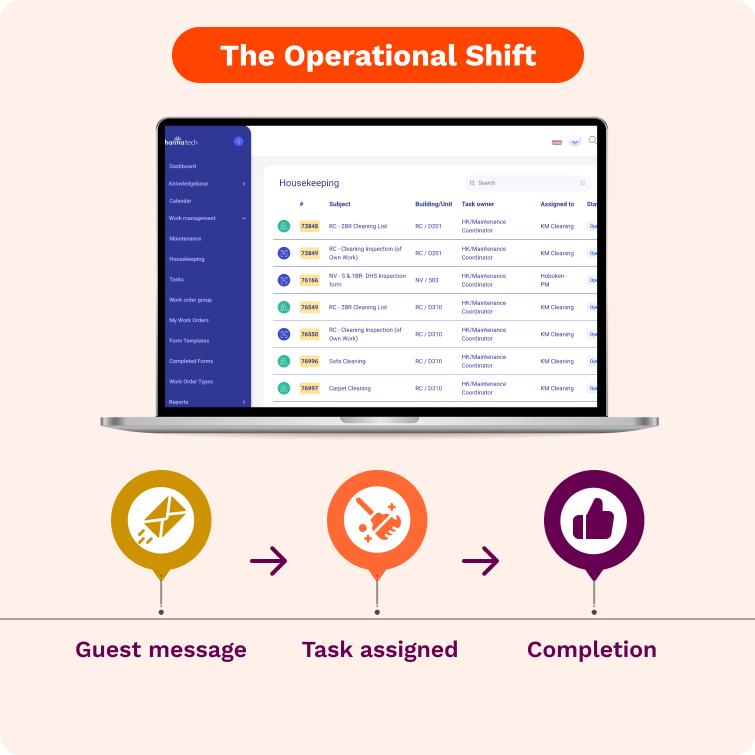
Rather than replacing front desks or staff, Dharma focuses on organizing the work that already exists. The platform connects guest communication, housekeeping, maintenance, and internal coordination into a single operational layer, so teams can act from shared, real-time information.
Instead of relying on multiple tools or manual follow-ups, teams can see what needs to happen, who is responsible, and when it is complete. Guest messages trigger tasks. Tasks update automatically. Managers gain visibility without micromanaging.
For hotels, this means fewer handoffs, fewer missed details, and smoother daily operations, especially in environments where teams are already centralized but workflows are not.
The future of hospitality is not a choice between models. It is about combining the strengths of both.
Hotels excel at consistency, on-site service, and human interaction. Vacation rentals show how flexible operations and proactive communication can reduce friction. The opportunity for hotels is to adopt these operational efficiencies while preserving the standards, accountability, and services that define hotel hospitality.
Hotels that evolve operationally will be better equipped to handle staffing challenges, rising costs, and changing guest expectations without compromising what makes hotel hospitality valuable.
Vacation rentals are growing because their operations align with how guests travel today and because their lack of physical infrastructure forced earlier technological innovation. Hotels can learn from this without losing their identity or their teams.
By modernizing operational workflows and supporting staff with better systems, hotels can improve efficiency, reduce pressure on teams, and deliver smoother guest experiences. The opportunity is not to replace people but to give them better tools.
Ready to reduce operational friction and better support your hotel teams? Book a discovery call with Dharma and let’s talk about how to make your operations unstoppable.

.svg)