
The AI revolution in hospitality has moved past the stage of flashy robots delivering towels. We’ve entered a more practical era. Today, it’s a fundamental operational tool that addresses the most persistent headaches in the industry: labor shortages, rising guest expectations, and the burnout of front-line staff.
For years, hospitality tech was focused on the front end, how guests find and book rooms. But the biggest challenge today lies in the middle, the daily grind of managing operations. Whether you are running a 50-room boutique hotel or a portfolio of 200 short-term rentals (STRs), the challenge is the same: guests want instant answers, and staff are stretched thin.
The industry is currently caught between a rock and a hard place. Operational costs are climbing, yet the pool of skilled labor remains shallow. According to the American Hotel & Lodging Association (AHLA) Newsroom, roughly 65% of hotels are still reporting staffing shortages as of early 2026. This is where AI steps in, not as a replacement for human warmth, but as an operational support system.
In a hotel, the front desk agent can physically see if a guest is struggling with the front door. In distributed hospitality, your front desk is a smartphone. If a guest is standing in the rain at a mountain cabin three miles from the nearest staff member and can't find the lockbox, that communication has to be instant and perfect. AI handles that last-mile support 24/7 without needing a staff member to be physically present at every rooftop.
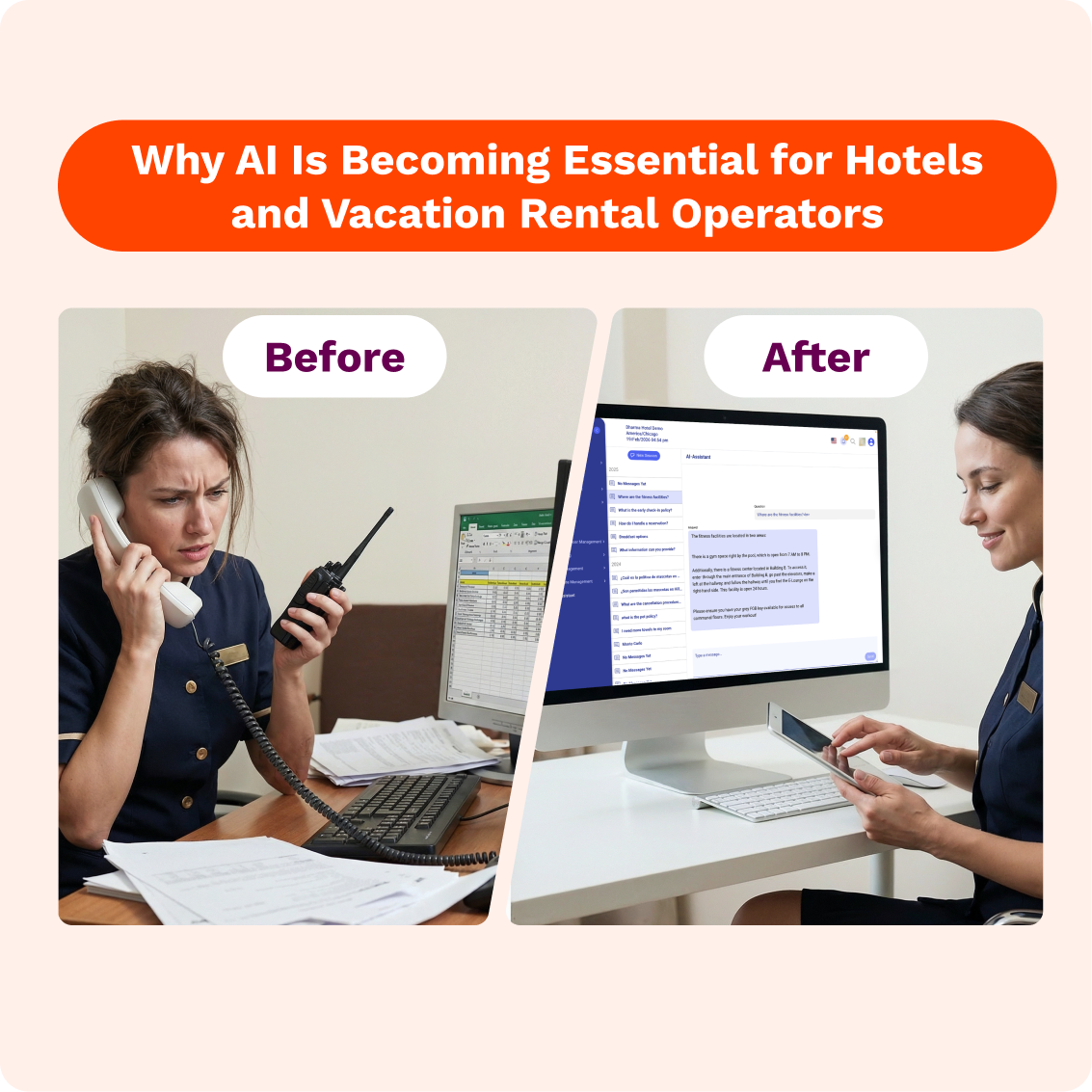
The most immediate win for any operator is automating the repetitive inquiries from guests, as most of them are predictable. By automating these, you free your team to handle the 20% where human empathy actually matters.
Whether a guest messages via WhatsApp, an OTA like Airbnb, or your direct booking site, AI ensures they aren't waiting for a shift change to get an answer. Modern AI models can now converse fluently in dozens of languages, removing the friction for international travelers.
When we talk about AI, we often focus on the guest, but the internal sanity check for your staff is where the real ROI lives.
Hospitality burnout is real. It stems from context switching, trying to manage a physical guest in front of you while three guests are blowing up your phone with the same question about late checkouts. AI acts as a digital air traffic controller, handling the noise so your team can focus on the person in the lobby.
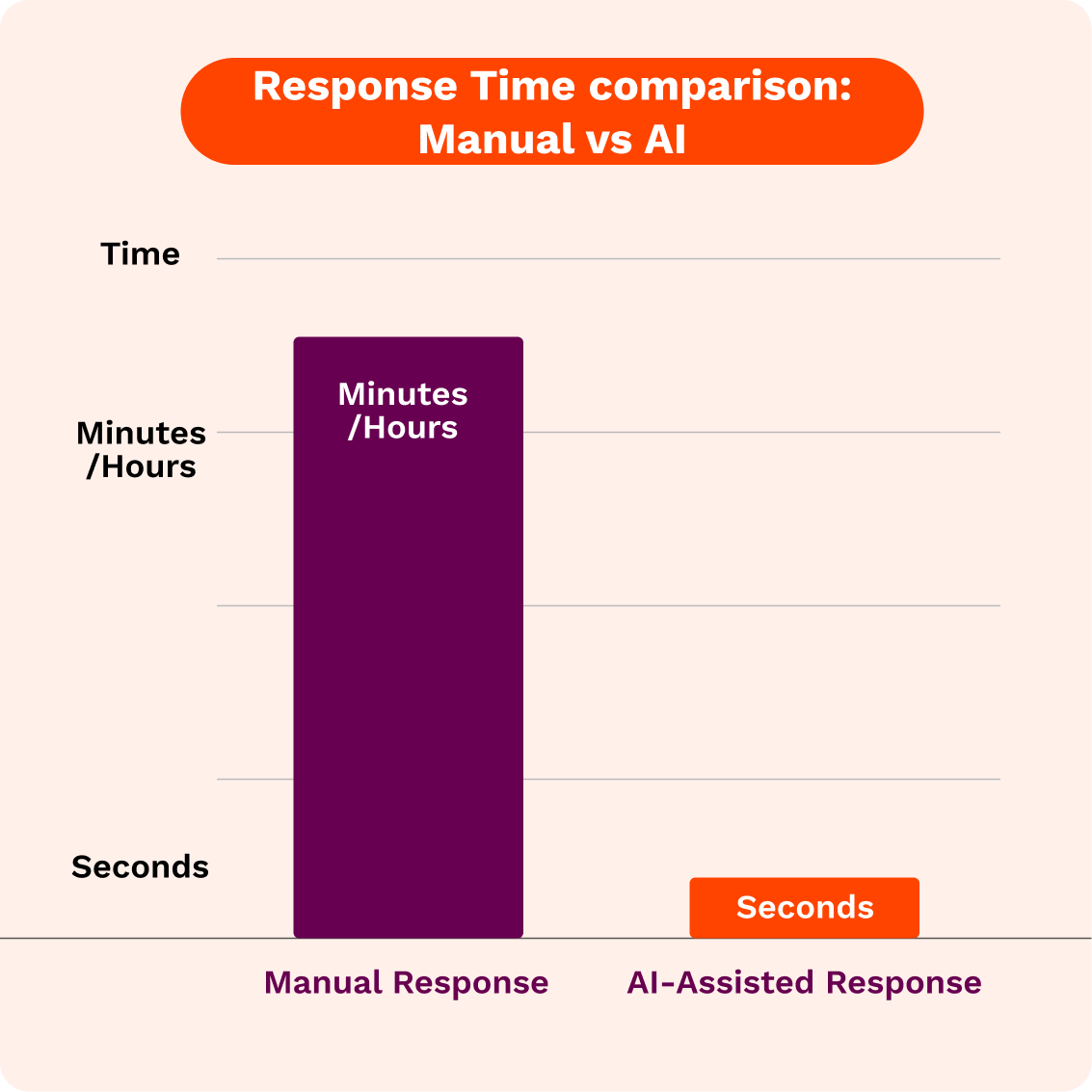
Speed is the number oEQ32ne driver of positive reviews on platforms like Booking.com and Airbnb. A ten-minute delay in responding to a "How do I turn on the heat?" message can be the difference between a 4-star and a 5-star review. AI drives these response times down to sub-30 seconds, 24/7.
Normally, guest questions are lost in individual chats or phone calls. AI-driven platforms categorize these interactions. If the data shows that 40% of your guests are asking for extra blankets, you have a clear operational signal: start stocking extra blankets in the rooms by default. This transforms chats into actionable business intelligence.
There is a lot of noise and fear surrounding AI. Let’s clear the air on why many operators hesitate when they shouldn't:
You don’t need to fire your property management system (PMS) or hire a developer to get started. The goal is incremental automation.
Identify Repetitive Processes First: Don't try to automate your whole business on Day 1. Spend one week tagging guest messages. You’ll likely find that 5-10 questions account for the vast majority of your volume. Automating just those ten answers will cut your communication workload by nearly half.
Prioritize Communication Over Complexity: The highest ROI comes from guest-facing AI. Start with an AI-driven messaging tool that integrates with your current OTA accounts (Airbnb, VRBO) and your website. This provides immediate relief to your front-desk or guest-relations team.
Choose Integrated Platforms: Avoid tech silos. If your AI doesn't know who is checking in today because it doesn't talk to your calendar, it's useless. Choose platforms that offer native integrations with your existing stack.
Measure ROI with Operational KPIs: Don't just look at it and feel better. Look at your Average Response Time (ART) and if it drops from 45 minutes to 1 minute, the system is paying for itself in labor hours saved and guest loyalty gained.
At Dharma, we’ve built the Operations Platform (OPS) to serve as the central nervous system for your property. We provide the foundational infrastructure that makes AI actually useful for your daily operations.
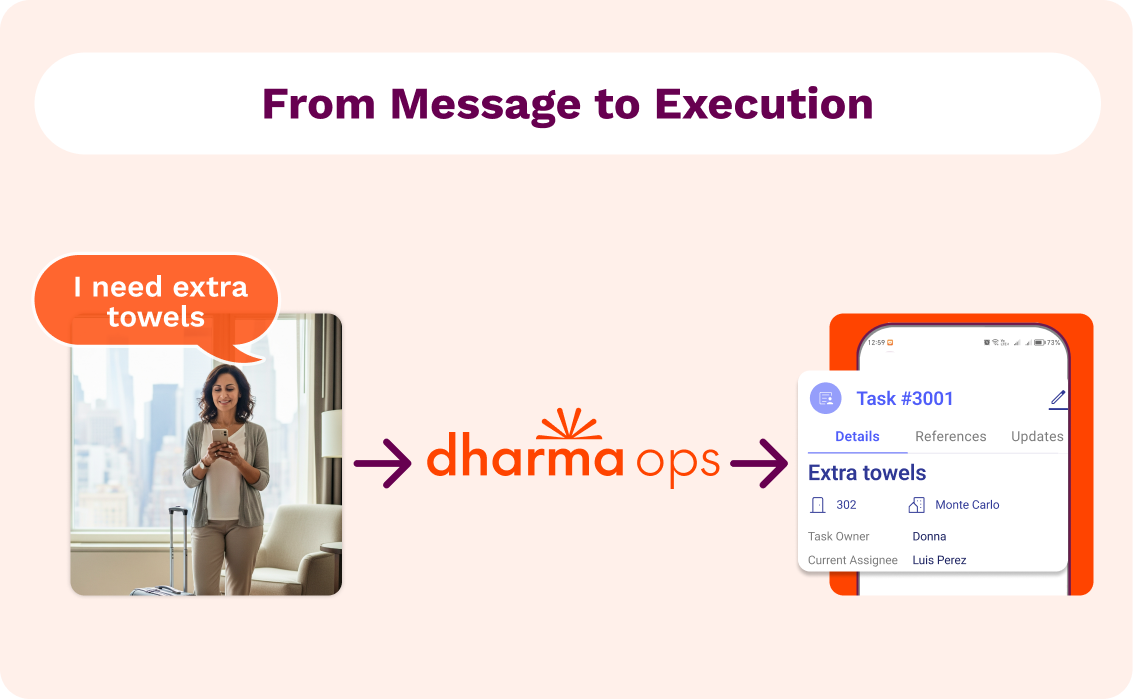
The OPS unifies guest interactions and internal operations into a single dashboard, linking communication and execution. Guest requests, from service to maintenance, are converted into structured, prioritized tasks, assigned to the correct team members, and tracked in real-time. This ensures seamless completion, improving team organization, response speed, and operational visibility.
Our platform is designed for the reality of both worlds:
By turning communication into organized action, the OPS ensures that your team, whether on-site or remote, always knows exactly what needs to be done next.
The goal of AI in hospitality isn't to create a hands-off business. It’s to create a heads-up business, one where your staff isn't buried in screens and repetitive tasks but is instead free to focus on the guest standing right in front of them. AI enhances the human element by removing the friction that usually gets in the way.
Ready to see how AI can transform your daily operations? Book a demo with Dharma today and let’s look at your specific workflow to see where we can save you time.


.svg)