
Every year the travel industry gathers somewhere. But not every gathering shapes the direction of the industry itself.
In March 2026, ITB Berlin turns 60. This matters a lot in the travel and hospitality industry because of what six decades growth represents. Since 1966, ITB has been the place where destinations position themselves, hotel groups test new narratives, and travel tech companies quietly compete for relevance. This year is not just another edition. It is a milestone moment for an industry under pressure.
More than 5,000 exhibitors and 100,000 visitors are expected in Berlin – a massive gathering of decision-makers, buyers, investors, operators and governments.
In this blog, we break down what matters, what to watch, and what to ignore so you can return from ITB, whether in person or following from afar, with clarity instead of noise.
ITB stands for Internationale Tourismus-Börse. Translated from German, it means International Tourism Exchange. The name is its purpose.
Founded in 1966 in Berlin with just nine exhibitors from five countries, ITB Berlin has grown into the world’s largest B2B travel trade show. What began as a modest exhibition is now a global marketplace where tourism boards negotiate strategy, hotel groups secure distribution partnerships, airlines plan routes, and travel technology companies compete for relevance.
ITB is strictly business-to-business. It is where destinations, travel sellers, investors, operators and tech providers meet under one roof. In 2025, the event hosted around 5,800 exhibitors from more than 170 countries and welcomed nearly 100,000 trade visitors.
Parallel to the exhibition runs the ITB Convention, the industry’s think tank. With roughly 200 sessions across 17 theme tracks and around 400 speakers from companies such as Expedia, Google, Booking.com, Sabre, TUI and UN Tourism, the agenda focuses on sustainability, AI, digital transformation and corporate strategy.
In 2026, Angola joins ITB Berlin as Official Host Country, spotlighting Africa’s rising tourism potential. For hoteliers, this signals new source markets, investment flows, and partnership opportunities. As emerging destinations gain visibility, distribution strategies and demand patterns shift, creating fresh opportunities for growth-minded operators.
The travel and hospitality conference does not just reflect what is happening in the industry but signals what comes next.
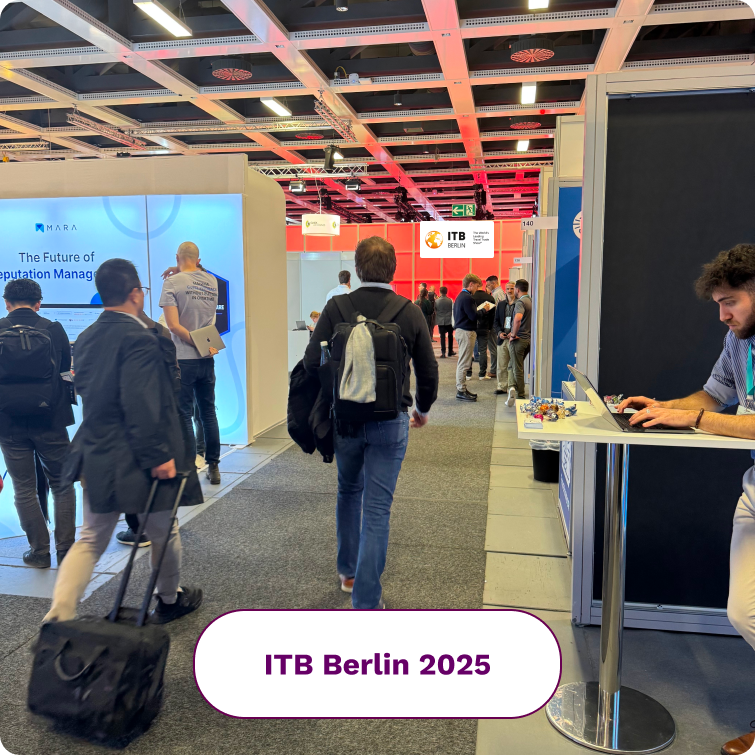
Every year, ITB announces themes and topics this year feel less like trends and more like concrete actions:
The AI conversations have moved on. Hotels are no longer asking, “Do we need AI?” They are asking, “Why is my team still overwhelmed?” Chatbots alone are not the answer. The real shift is AI embedded into operations.
Expectations for hospitality tech have shifted. Operators are tired of "shiny" features that don't solve real problems. They need tools that work as hard as their staff do. Technology should shorten housekeeping turnaround times. It should centralize maintenance tasks. It should reduce WhatsApp chaos and email backlogs. It should make it easier to manage multiple properties without adding more managers.
If a tool does not improve staff workload or guest communication clarity, it is not hospitality tech.
Sustainability is everywhere on the agenda for the good. But reporting dashboards is not sustainable. Sustainability should be in operations with fewer unnecessary room cleans, smarter maintenance schedules, reduced rework and better coordination that avoids waste.
For hotels, green tech must cut inefficiencies. Because reducing operational waste is good for the planet. And it is good for financial margins.
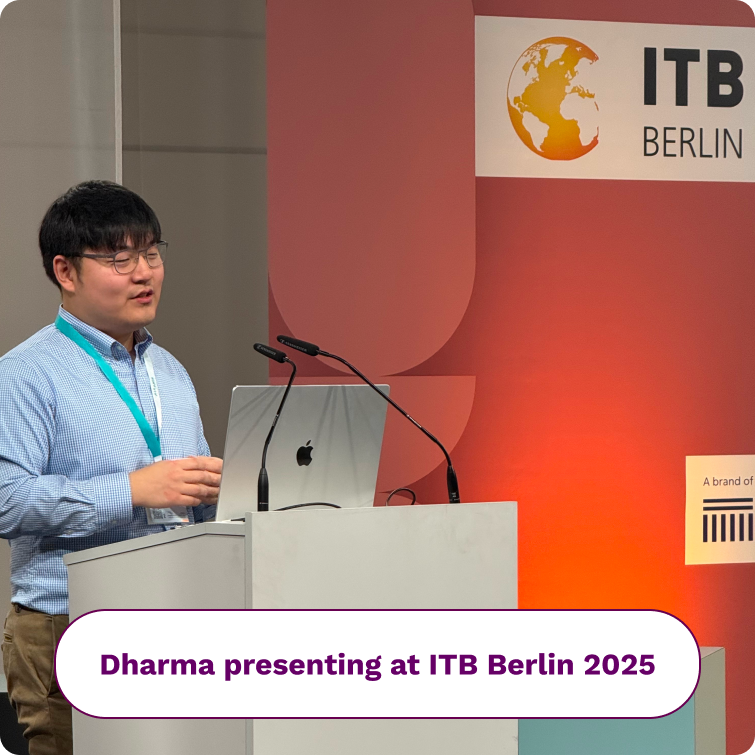
At ITB 2025, our conversation centred on AI in hospitality. Real use cases. We spoke about the opportunities AI brings to hotels, but also the practical limits. Data quality. Privacy. The reality that every property operates differently. Generic AI does not understand property-specific workflows.
We explored what the future could look like: hyper-personalised guest communication, smarter forecasting, deeper data analysis, and human–AI collaboration instead of replacement. We shared early thinking around AI auto-assigning housekeeping tasks based on priority, room status and staff availability. We demonstrated personalised guest chats that adapt to property tone and context.
Since then, the shift has been clear for us. We are now testing tighter workflow integrations, stronger knowledge bases and clearer reporting so AI becomes part of daily operations, not a side experiment.
There is genuine optimism around what this new wave of AI and operational systems can unlock for hospitality. For us, it is about well-coordinated operations during peak demand and better visibility across teams.
This year, we are bringing better tools and clearer outcomes.
Our Task Management system is built to simplify housekeeping and maintenance across properties. Clear ownership, real-time updates, no chasing messages across channels. Managers see progress instantly and teams know exactly what to do next.
We look forward to demoing our latest developments in person with potential clients and partners and showing the real-world impact of these tools. So, if you manage hotels, short-term rentals, or build travel tech integrations, let’s talk – meet us at our booth in Hall 10.1, Stand 111. A 15-minute chat means understanding your current stack, your operational bottlenecks, and mapping the next step.
Book a meeting. Message us. Follow our ITB updates.


.svg)