
While full occupancy is often chased as the ultimate KPI, it can be a deceptive metric of success. During mega-events like FIFA, the surge in demand creates a rare window where hotels can achieve both peak rates and 100% occupancy simultaneously—a combination that, on paper, suggests peak profitability. However, theory and practice often collide at the front desk. Data from STR by CoStar suggests that hotels typically reach peak profitability at 71-84% occupancy. Beyond this threshold, the law of diminishing returns sets in.
As demand spikes toward total capacity, operational strain intensifies, often exposing hidden inefficiencies. In the age of instant feedback, a week of full occupancy plagued by poor guest experiences can lead to a long-term deficit in reputation and profitability that far outweighs a few nights of record-breaking ADR. This blog explores how hotels can prepare operationally to stay in control during FIFA-level demand.
Past mega events offer a clear lesson: demand may surge overnight, but operational pressure builds just as fast. As per Hospitality Net, during the FIFA World Cup in Qatar 2022 and Paris Olympics in 2024, host cities saw occupancies touch near-capacity (90-95% occupancy). A sold-out hotel puts sustained strain on operations and on the teams on the ground.
Day-to-day operational pressure is already high. During peak periods, this pressure intensifies as teams are forced to resolve additional issues such as check-in errors, name mismatches, incorrect credit card details, and billing disputes. Each correction adds friction to already stretched workflows, compounding delays and increasing the risk of guest dissatisfaction.
In this environment, there is very little tolerance for error. One delayed room status update is rarely contained to one department. Housekeeping pauses, waiting for confirmation. Maintenance is notified late. Guests arrive expecting access and are asked to wait. The front desk takes the pressure, handling frustration that was never created at the desk itself. What starts as a small internal delay quickly becomes a visible guest issue, directly affecting satisfaction scores, online reviews, and ultimately revenue.

Now scale this pressure to a FIFA-level event. Around 5.5 million fans are expected to travel across three host countries, with 104 matches played over 39 days and guests moving continuously between Mexico, the United States, and Canada. For hotels and short-term rentals, this creates a high-volume, high-velocity operating environment. Every weakness in systems, handovers, or task tracking is amplified. At the same time, well-structured operations have the opposite effect – guest experience improves consistently, even at full occupancy.
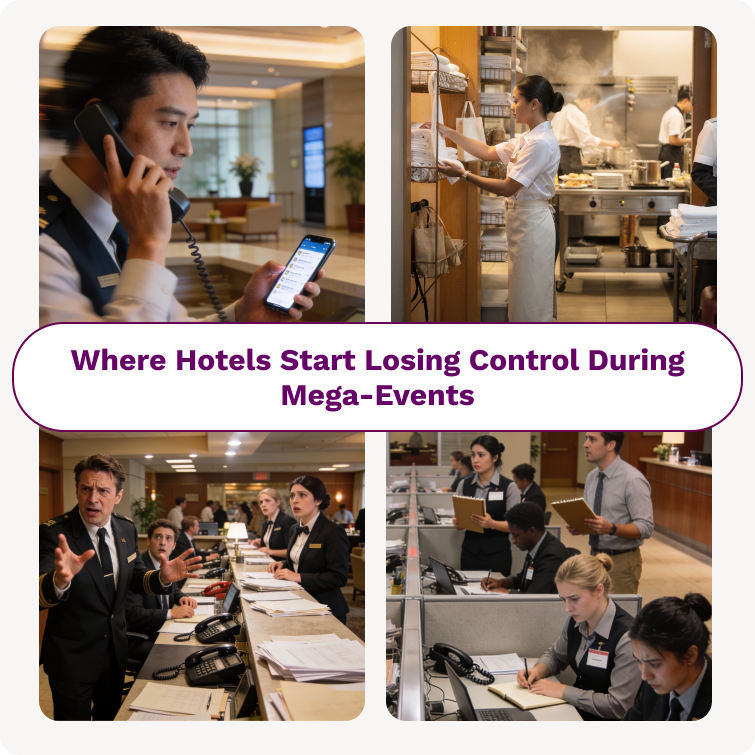
During peak events, expectations for response speed rise exponentially. During peak events, guest expectations for response time rise sharply. Travellers coordinating matches, transport, and tight schedules expect immediate clarity. Yet industry research shows that even in normal conditions, only around 40% of hotel calls are answered, with some properties missing up to 73,000 calls annually. During event periods, call and message volumes surge while team capacity stays flat.
At the same time, communication fragments across email, WhatsApp, booking platforms, and phone calls. With a centralized inbox powered with AI, chat history is maintained so staff responses are consistent even if the front desk is strained. What could have been missed messages becomes an opportunity for personalized service leading to guest satisfaction and positive reviews.
Peak events push room turnover to its limits, and this is where operational gaps surface fast. Tasks are often reported verbally, passed between shifts, or left without clear ownership, which slows prioritisation and delays critical fixes. As a result, rooms remain blocked longer than necessary, even when demand is at its highest.
Research from Cornell’s Center for Hospitality Research shows that a check-in wait beyond five minutes can reduce guest satisfaction by 47%, a sharp penalty during sold-out periods. With a well-integrated task management system all tasks can be recorded in the system so that no guest request is missed and rooms are ready before time as per the booking calendar.
This matters because cleanliness remains a decisive factor, with 85% of guests citing it as central to their overall stay according to a study in the Journal of Business and Economics Research.
While demand is higher and a hotel can command a higher ADR, it doesn't always translate to easy cash-flow. During peak season, property managers will need to hire more staff, order more supplies, and pay high energy costs to offer the quality of high prices.
Sold-out periods force hotels to bring in additional staff, often on a temporary basis, at the very moment operations are under the most strain. These team members still need to understand the property, workflows, and systems to be effective. When tools are complex or inconsistent, onboarding stretches from days into weeks, adding friction instead of relief. This matters because hiring itself already carries a cost, and time spent learning systems during peak demand directly impacts service quality. At the same time, staffing shortages remain structural rather than seasonal. The American Hotel and Lodging Association reports that 48% of hotels cite housekeeping as their most urgent hiring need, intensifying pressure on already stretched teams during high-demand events.
Simple, easy-to-learn tools and a centralized, AI-powered property database help staff train themselves, significantly reducing onboarding time. Industry data shows that 92% of operators say modern PMS interfaces significantly reduce training time, turning onboarding from weeks into days.
Without a unified dashboard, teams rely on different systems and incomplete information. Answers vary, shift handovers lose critical context, and the same issues repeat. Small inefficiencies compound quietly until they surface as visible guest dissatisfaction and operational breakdowns.
Dharma OPS acts as the operational backbone without replacing your existing hotel tech systems during peak demand:
With Dharma OPS, sold-out periods remain demanding but no longer break the operation. Staff stay focused, guest service stays consistent, and peak events are navigated with confidence.
81% of hoteliers believe it’s very likely that technology will be more important for the success of a hotel business in the next five years. If you embrace technology and modern tools, big events should feel busy, not chaotic. Hotels that invest in clear operational workflows and integrated systems gain a tangible competitive advantage, not just during FIFA but every high-demand period. Want to know more about how Dharma OPS can make your hotel FIFA ready? Book a demo!


.svg)