
It’s a sold-out evening. Group check-ins arrive together. Housekeeping is racing to turn rooms. Guest messages keep coming in. Rates still need updating across channels. Long queues at the front desk. Everything is “handled”, yet everything is late.
Now imagine the same evening with your automated hospitality software. Checkout triggers housekeeping instantly. Rooms are ready before arrivals. Guests receive property details in advance. No queues, no confusion.
This gap between expectation and reality is not failure. It is lag, the overlooked hidden cost of manual hotel operations.
In this article, we examine where pressure builds when automation is missing. We aim to help you quantify the cost of manual coordination on your staff productivity and hotel revenue. It is an invitation to assess whether your current operation management software is truly supporting the optimal operation you want to run.
Recent studies reveal that companies lose an average 14.9 percent of revenue to manual errors and outdated processes. And this is not new in hospitality. But manual hotel operations rarely collapse in obvious ways. They absorb pressure slowly. Tasks get done, guests are managed, teams adjust, and the day moves forward. Over time, though, small issues begin to stack up and demand more attention, time, and money, than they should.
Hotels deal with hundreds of routine tasks every day. Assigning housekeeping, sending pre-arrival emails, updating reservation notes, logging maintenance issues. Each of these actions matters, yet when they are handled manually, they start to pull teams away from service and toward constant coordination. What should feel routine begins to feel heavy.
When data is spread across spreadsheets, emails, and WhatsApp, coordination relies entirely on manual follow-ups. Managers spend time looking for updates instead of managing priorities. Front desk teams stall while waiting for confirmations. Housekeeping operates with incomplete information. The hotel keeps running, but it’s fueled by a constant delay that keeps building and drains efficiency.
Many hotels still depend on WhatsApp groups, walkie-talkies, handwritten notes, or verbal handovers to assign jobs and record tasks. These methods feel fast in the moment but create confusion over time. Rooms are not ready, maintenance issues surface late, and task ownership becomes unclear across shifts.
All this is not because teams are careless, but because information does not live in one place. Also, without clear tracking, hotels assume how much time housekeeping or maintenance takes. When tasks are finally measured, inefficiencies become visible and workflows naturally improve.
Guest communication is one of the most demanding parts of daily operations. Questions arrive before check-in, during the stay, and at checkout. Without automation, responses depend on availability rather than timing. Slow or missed replies add friction to the guest journey and quietly increase staff workload.
Paper notes, printed reports, and manual logs still sit in the background of many operations. Information gets lost or delayed, data is not searchable, and teams spend time documenting rather than acting.
Hotels and short term rentals often use a PMS, booking platform, CRM, and other tools that operate independently. When such systems do not share information, teams fill the gaps manually. This adds inconsistency and even more delay. However, a well-integrated tech stack shapes how smoothly operations run and how quickly teams respond.
When processes are manual and systems are fragmented, training relies heavily on experience and thus can vary in standard. New staff take longer to become effective, consistency varies by shift, and operational knowledge stays with individuals rather than the system.
Day-to-day friction stays quiet for a long time. Teams adjust, work around it, and keep the hotel running. The real test begins when demand peaks and every small delay is exposed at once.
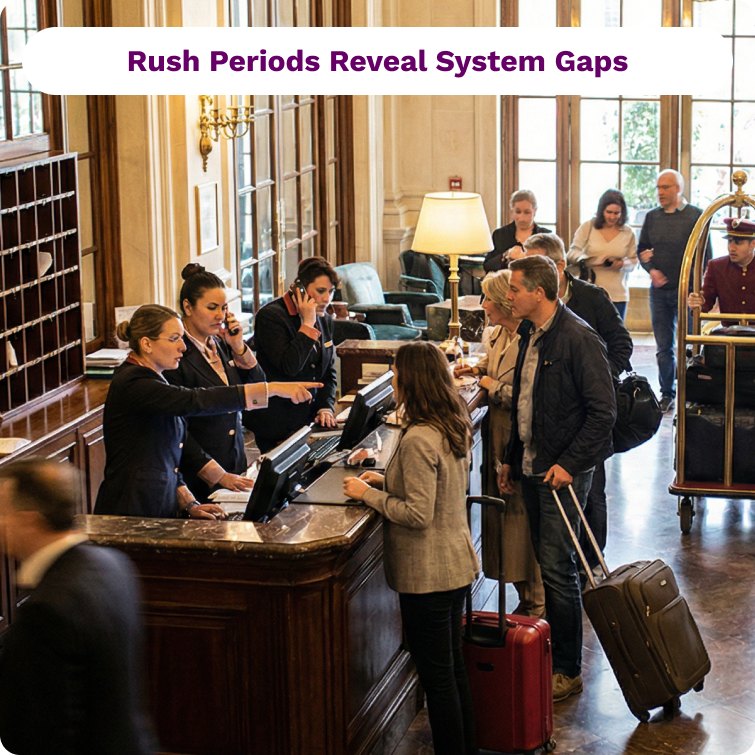
During rush hours manual operations show their limits. Because manual, outdated systems rarely fail on slow days. As volume increases, decisions speed up, and coordination becomes fragile. What worked at a moderate pace starts to break under pressure. See how:
These are just a few of the issues but the impact is immediate and huge — inconsistent service, weakened guest trust and lost revenue.
Every missed update, delayed message, and manual mistake weighs on your team.
Your hotel may appear busy, but energy drains quietly, smiles fade, and service falters. AI-powered hospitality operations platforms don’t just save time, they preserve your team’s focus, keep guests delighted, and capture revenue before it disappears.
It may look like your competitors are working harder, but many are working smarter, supported by modern systems that keep teams confident and guests satisfied. While pressure builds quietly, others move ahead with clarity and control. Over time, catching up becomes harder than moving forward.

Dharma OPS supports hotels when pressure is highest. Guest messages stay in one place, teams receive clear tasks, and housekeeping and maintenance move in real time. AI assists staff with accurate answers, even during rush hours. Training becomes easier, coordination sharper, and nothing slips through. It works as a smart layer over your existing systems, integrating seamlessly without replacing your PMS.
Every day without automation adds small delays, quiet stress, and avoidable revenue loss. Hotels that move early create steadier operations, more confident teams, and guest experiences that hold up under pressure. Others continue to absorb the same load, only with increasing effort.
Dharma Tech OPS supports daily hotel operations with automation and AI, helping teams stay aligned and responsive as demand grows. If this reflection resonates, explore our basic hotel automation workflow guide to understand what smoother operations can feel like. Book a demo to see the platform in action.

.svg)