

You can criticize Online Travel Agencies (OTAs), depend on them, or try reducing them, but ignoring them is no longer realistic. OTAs now influence over $400 billion in global bookings in global travel bookings every year and shape how travelers discover, compare, and book stays.
This blog breaks down how OTAs actually work, where they genuinely help hotels and vacation rentals, where they create pressure, and how hospitality businesses can use them more strategically and profitably long term.
What Otas Actually Are (And How They Make Money)
Online Travel Agencies (OTAs) are third-party platforms that aggregate accommodation inventory and sell it to travelers through a centralized marketplace. Before OTAs emerged in the mid-1990s, hotel bookings largely depended on travel agents, phone reservations, airline reservation systems, tour operators, and walk-ins.
As internet usage expanded, travelers increasingly wanted faster price comparison, instant booking confirmation, reviews, and global accommodation access in one place. OTAs evolved to solve this growing friction in travel planning and quickly became one of hospitality’s most influential distribution channels.
Over the last two decades, OTAs fundamentally changed how travelers discover, compare, and book accommodations. For hotels and vacation rental operators, understanding how OTAs make money is critical because each model affects profitability, cash flow, guest ownership, and operational control differently.
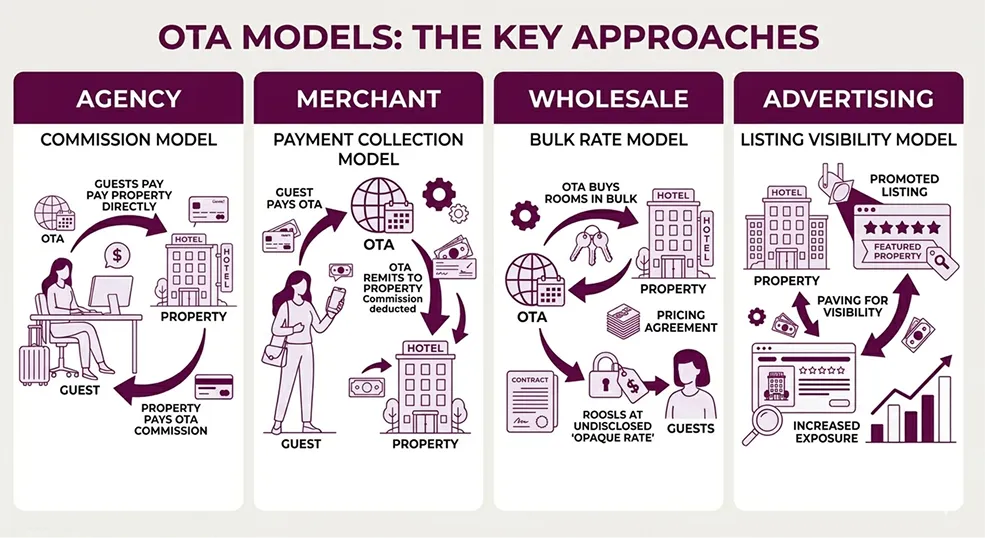
The Four Core OTA Revenue Models
- Agency Model: The most common type where the guest pays the property directly and the OTA later charges commission, typically between 15% and 30% depending on market leverage, visibility, and property type. Smaller independent hotels and rentals often pay higher commissions than global chains. Booking.com primarily runs this model but also sells promoted placements.
- Merchant Model: The OTA collects payment upfront, keeps its margin, and remits the remaining amount to the property. This gives OTAs greater control over pricing, refunds, and packaging. Expedia runs the merchant model for packages but uses the agency model for standalone hotel bookings.
- Opaque or Wholesale Model: OTAs buy discounted inventory in bulk and resell it at marked-up rates, often without fully revealing pricing structures to guests. Priceline offers both opaque and transparent rates.
- Advertising Model: Properties pay for visibility through sponsored listings, preferred placements, or pay-per-click campaigns. This model has grown significantly with metasearch platforms and Google-driven travel discovery.
Properties now use a combination of all four models depending on occupancy targets, seasonality, and distribution strategy.
The Good: Real Advantages of OTAs
- Unmatched Distribution Reach: OTAs give independent hotels, vacation rentals, and newer properties instant access to global demand. Before OTAs, smaller operators relied heavily on travel agents, phone bookings, or local visibility. These platforms spend billions annually on digital marketing, helping smaller properties reach travelers across multiple countries without building large marketing teams.
- Brand Discovery: Research from the Cornell School of Hotel Administration estimated direct-booking uplift between 7.5% and 26% because travelers often discover hotels on OTAs before later searching and booking directly through the hotel website.
- Reviews and Social Proof: OTA review systems have become major trust signals. Strong scores on these platforms frequently improve conversion rates across both OTA and direct channels.
- Technology and Operational Support: OTAs provide smaller hotels with pricing insights, demand data, payment systems, multilingual exposure, customer support, and centralized booking management without requiring large in-house teams or technology investment.
The Bad: Real Costs of OTAs
Apart from operational complexity, OTA dependency, and increasingly aggressive competition, properties face these challenges:
- Increased Commission: What started at 10% in the early 2000s now ranges from 15–30% standard, hitting 30–40% effective rates when Genius discounts, Preferred Partner tiers, and promoted listings are included. A 200-room hotel at 20% commission with high OTA dependence could pay nearly a billion annually in OTA commissions alone.
- Rate Parity Clauses and Pricing Control: Many OTA contracts historically required hotels to maintain the same or higher prices across all channels, preventing cheaper direct rates. Although several European regulators ruled such “rate parity” clauses anti-competitive, hotels still risk lower visibility or reduced promotional placement if they undercut OTA pricing.
- Guest Ownership Problem: When a guest books through an OTA, the OTA owns the customer relationship. Properties often receive masked contact details and cannot run pre-arrival upsell sequences, enroll guests in loyalty programs, or build a direct CRM relationship. Skift survey highlights 80%+ of hoteliers say direct customers are "likely" or "much more likely" to become repeat guests vs. OTA customers.
- Algorithm Dependency and Visibility Costs: Not all OTA rankings are neutral. Properties can pay to have more visibility on OTAs to appear higher in search results or have premium sponsored positions. Negotiation leverage dictates commission sizes. Large hotel chains leverage their massive property volume for lower rates, leaving independent hotels to pay a premium.
- Cancellation Rate Exposure: According to Cloudbeds’ 2026 report, OTA bookings had a 21.8% cancellation rate versus 10.6% for direct bookings. Because OTAs aggressively promote flexible cancellation policies to attract travelers, but properties absorb the operational and revenue impact.
The Strategic Framework: Balancing OTA Reach with Direct Bookings
The most successful hospitality businesses do not view OTAs as enemies, nor do they rely on them as their entire strategy. Instead, they deploy them deliberately: to acquire new guests, protect occupancy during weaker periods, and boost market visibility, while gradually systematically converting guests into direct relationships over time.
- Use OTAs for discovery, not dependency: Use OTAs primarily for market entry and expansion. Dutch hotel brand citizenM used OTAs heavily when entering new cities to quickly build awareness and review volume, while encouraging repeat guests into its own loyalty ecosystem. This balanced approach helped the brand maintain strong direct-booking performance.
- Add concrete value into direct bookings: Give guests a reason to bypass OTAs. This shift is already underway: Skift Research projects that direct digital channels could overtake OTAs as the dominant hotel distribution channel by 2030. This shows hotels investing in guest relationships, technology, and brand experience today will gain stronger long-term control over their distribution mix.
- Diversify OTA exposure: Relying too heavily on one OTA creates risk if rankings, algorithms, or commission structures change. Smart operators diversify their inventory across multiple platforms, such as Booking.com, Expedia, Agoda, Airbnb, and regional channels, to reduce dependency and protect revenue.
- Invest in connected hospitality systems: Your PMS, channel manager, booking engine, revenue management system, and CRM should work together smoothly. When systems are connected, hotels can manage rates, inventory, cancellations, and guest data efficiently and accurately reducing manual errors. According to SiteMinder, hotel websites generated higher average booking values than OTAs in 2024, proving the clear ROI of robust and integrated direct-booking infrastructure.
- Negotiate terms instead of accepting defaults: Never treat OTA contracts as set in stone. Commission rates, visibility programs, and cancellation policies are often negotiable, especially for properties that consistently deliver strong occupancy, high review scores, and reliable revenue performance.

Are you using OTAs strategically?
OTAs have become a permanent part of modern hospitality distribution because they solve real traveler and business needs. The challenge for your property is not whether to use them, but how to use them strategically.
Use OTAs as one part of a broader distribution mix, so you can balance visibility, occupancy, profitability, and long-term guest relationships without becoming overly dependent on any single channel.