
Hospitality tech feels more confusing than ever because hotels and STR operators no longer rely on a single system. Today’s industry runs on multiple tools across operations, distribution, and guest experience. The challenge is not the number of systems, but how poorly they connect, leading to manual work, unclear reporting, and data gaps. As digitization expands, no true all-in-one solution exists.
With 57% of hotels seeing revenue growth from tech adoption, getting integrations right is now critical. This blog simplifies the landscape by explaining what integrations are, why they matter, and how to choose the right setup.
In simple terms, integration is where different software work together, each used for a specific purpose, to make hospitality operations easier and smoother. Instead of entering the same information multiple times, updates in one system reflect across others, keeping operations aligned and reducing manual work.
Integrations work through APIs that allow different systems to exchange data automatically based on defined rules, removing the need for manual entry. The PMS acts as the central hub, where all connected tools sync data to maintain a single source of truth. As actions happen, such as bookings or room cleaning, updates flow instantly across systems, keeping operations aligned in real time.

PMS sits at the center, connected to a broader tech stack of the following specialized systems:
• Property Management System (PMS): Core system for reservations, check-ins, and billing
• Point of Sale (POS): Manages transactions and inventory across outlets
• Customer Relationship Management (CRM): Stores guest data for personalized experiences
• Revenue Management System (RMS): Optimizes pricing and inventory
• Central Reservation System (CRS): Centralizes bookings across channels
• Channel Manager: Syncs rates and availability across OTAs
These are the core systems. Additional tools can be added based on operational needs:
• Wi-Fi & Connectivity: Enables personalized digital guest experiences
• IoT & Smart Systems: Supports automation, energy, and maintenance
• Back-Office Systems: Accounting, HR, and inventory management
• Security Systems: Access control and surveillance
• Mobile Applications: Guest apps for booking, check-in, and services
Each system performs a specific role but stays connected through integrations. For example, when PMS, RMS, and channel managers are linked, room rates update automatically across all channels. When housekeeping tools connect to the PMS, room status updates instantly after checkout, improving coordination.
Modern hospitality tech relies on integrations because no single system can handle everything. Without them, data remains siloed, operations become fragmented, and teams struggle to respond quickly. Strong integrations improve efficiency and enable better decision-making.
Good integrations go beyond connecting systems. They create a unified, real-time operating environment that improves efficiency, guest experience, and control. Research shows that hotels with right integrations can improve operational efficiency by up to 30% and guest satisfaction by up to 15%.
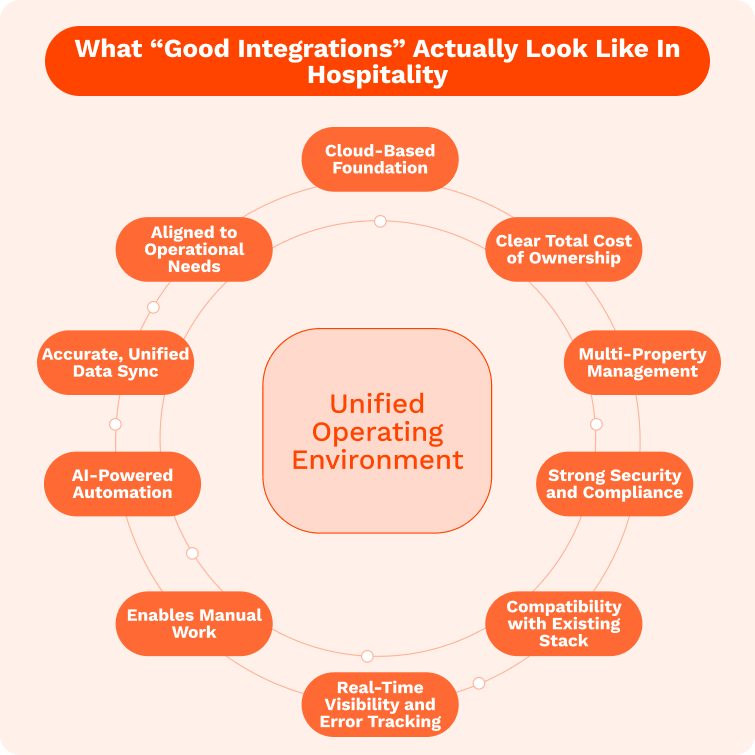
Factors that make integrations work better:
But above all, a good integration setup means: no repeated manual work, no delays in updates, no data mismatch across systems and clear impact on efficiency, revenue, and guest experience.
Most integration failures don’t come from bad software, but from gaps in planning, data flow, and ownership. Start by understanding your property’s needs. A boutique hotel may prioritize personalized guest communication, while a business hotel may focus on conference tools, upselling, and connectivity.
Integration traps to avoid are:
• How long will full implementation take for our property type?
• What level of staff training is included, and in what format?
• How do you support onboarding for non-technical staff?
• What are the most common challenges during setup, and how do you solve them?
• Will we need internal resources or IT support during implementation?
• How does this system fit into our current day-to-day workflows?
• Which manual tasks will this replace or reduce immediately?
• How do different teams (front desk, housekeeping, maintenance) use it?
• Can we track tasks, performance, and accountability in one place?
• What operational improvements have similar properties seen?
• Can this system support multiple properties or locations easily?
• How does it handle increased bookings, staff, or guest volume?
• Can we add new features or integrations as we grow?
• Will performance remain stable during peak demand periods?
• Is the system flexible for different property types (hotel, rentals, hybrid)?
• Who is responsible if integrations fail or data doesn’t sync?
• Do you manage integrations directly or rely on third parties?
• How much control do we have over workflows and configurations?
• What happens if we want to switch or add another system later?
• Who owns the data stored in the system?
• What is the total cost beyond subscription (setup, integrations, training)?
• Are there additional charges for APIs, support, or upgrades?
• How does pricing scale as we add rooms, users, or properties?
• What ROI should we expect, and in what timeframe?
• Are there long-term contracts or exit costs?
• What data is synced in real time, and what is not?
• Is the integration one-way or two-way across systems?
• How do you ensure data accuracy and prevent duplication?
• What security measures protect guest and operational data?
• How do you handle data compliance and privacy regulations?
• What is your uptime guarantee and SLA commitment?
• How quickly does your team respond when systems go down?
• Do you offer 24/7 support, especially during peak periods?
• Is there a dedicated account manager or support contact?
• How do you proactively monitor and resolve system issues?
Think long term. The goal is not to buy more tools, but to create systems that work together seamlessly to support operations, guest experience, and revenue growth. Marriott invests over $1 billion annually in building and maintaining integrated technology ecosystems.
Ready to build a tech system that actually works for your operations? Follow us for more insights and explore how Dharma OPS can help you connect, automate, and scale with clarity.


.svg)