
Industry research shows language barriers are a major source of dissatisfaction in guest service. If you are running a hotel today, multilingual support is an operational necessity. Sporting events, leisure demand and global connectivity are bringing more international guests to your doorstep. Many do not speak the local language. They arrive at unpredictable hours and expect fast, clear responses across every touchpoint. At the same time, your teams are already stretched. Guest expectations are rising faster than operational capacity.
This blog explores why multilingual support matters now and how you can implement it effectively within your hotel operations.
Imagine a family from Chicago booking a beachfront resort in Mexico. A few days before arrival, they message about airport transfers, safety in the area and whether tap water is safe. The reply from the resort is slow and written in unclear English. Doubt sets in the guest's mind. They begin to reconsider their accommodation choice.
Now imagine the same message answered instantly in fluent English, with clear details, safety reassurance and a prepaid shuttle offer. Confidence rises. They keep the booking and upgrade their room.
This is where language becomes operational. It begins with pre-arrival questions that sit unanswered or are misunderstood. Then it moves to check-in, where small miscommunications slow down the front desk and create tension. During the stay, housekeeping or maintenance requests can lose clarity in translation. Your front desk team often steps in as informal translators, diverting their attention from main services.
The impact shows up commercially. According to Language IO, 40% of customers refuse to book on websites not offered in their native language. While 71.5% of hospitality leaders say native-language support increases satisfaction.
Each gap adds friction, and friction affects revenue.
Why Human-Only Multilingual Support Does Not Scale
If your first instinct is to hire more multilingual staff, it feels logical. More languages, more people, better service. In practice, global demand moves faster than staff count.

Take large-scale events as an example. During Paris 2024, around 68% of bookings (nearly 1.2 million visitors) came from international guests. That means multiple languages, time zones and expectations converging at once. A people-heavy model quickly breaks under that kind of pressure. Properties face these constraints:
Scaling teams without scalable systems adds more strain than solving the translation concerns. Scalable multilingual infrastructure creates consistency, speed and operational control.
The demand for multilingual customer engagement technology is accelerating. The global conversational AI market is projected to grow at a CAGR of 24.9% from 2024 to 2033. This growth reflects a structural shift in hospitality: language capability is becoming part of operational infrastructure.
Automated multilingual support influences more than amenities. It shapes reliability, responsiveness and perceived service quality. Research consistently shows that effective communication strengthens emotional comfort and overall satisfaction. When guests are served in their native or preferred language, they experience higher perceived value and stronger emotional engagement. In contrast, linguistic mismatch during service encounters is linked to lower brand loyalty and more negative online reviews.
A traveler in Spain attempting to book an Australian hotel package may misinterpret the term “non-refundable” if the policy feels unclear. That hesitation often leads to abandoned bookings. With 24/7 automated multilingual assistance, the same traveler can confirm details confidently in their preferred language. You get the booking, trust increases and conversion improves.
The impact is measurable:
Technology strengthens this further:
According to Harvard Business Review, 72.4% of consumers are more likely to buy when information is in their own language. 56.2% say language matters more than price. Clear communication helps hotels increase upsells, improve guest satisfaction, and build long-term loyalty.
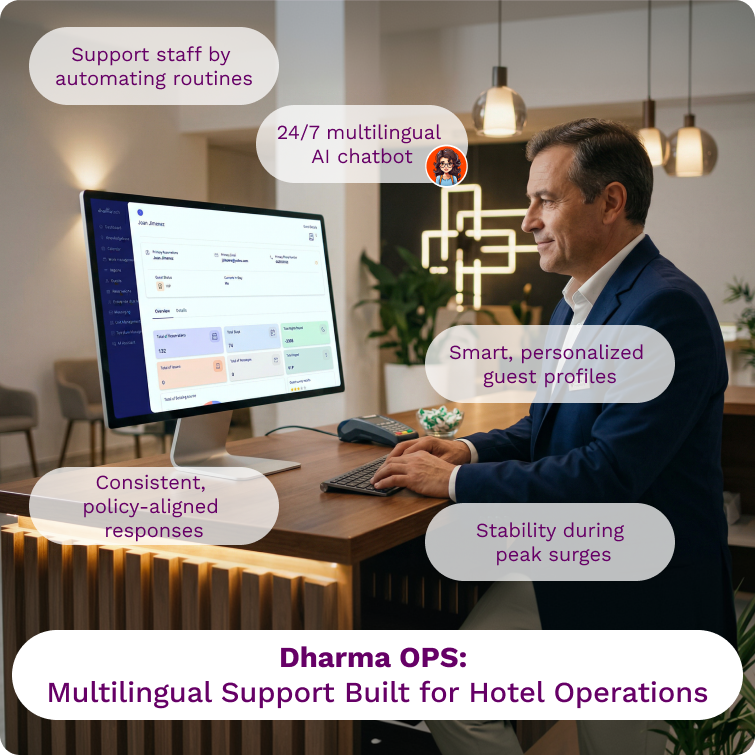
Dharma OPS is designed around how hotels actually function day to day. It works with your existing systems rather than replacing them, embedding multilingual communication directly into workflows.
Travel will continue to globalize. Cross-border leisure, business travel and international events are expanding guest diversity in every destination market.
Multilingual support systems are now part of core operational resilience. The properties that embed language into their operational backbone will move faster, convert more bookings and deliver more consistent experiences across markets. Want to know how Dharma OPS can help you achieve that?


.svg)