

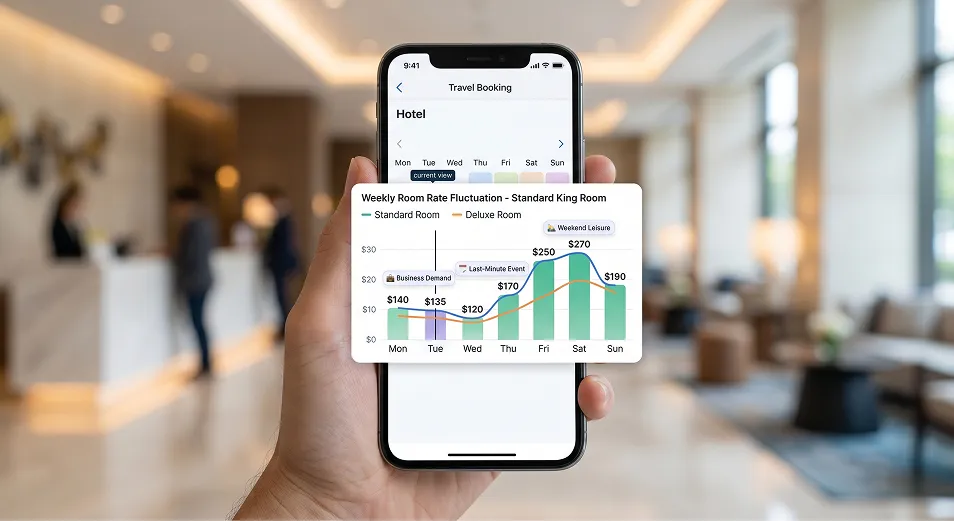
Check a hotel rate on Tuesday, and by Thursday it’s $50 higher. Not random. That’s dynamic pricing at work. Every unsold room is perishable. Once the night passes, that revenue is gone forever. Sell too early at low rates, and you miss high-value last-minute demand.
The real challenge is timing. When should you raise rates, hold, or drop? Most hotels react too late. In this blog, we break down when to adjust prices, what signals to track, and how to move from reactive to confident pricing decisions.
What is Dynamic Pricing in Hospitality and its needs?
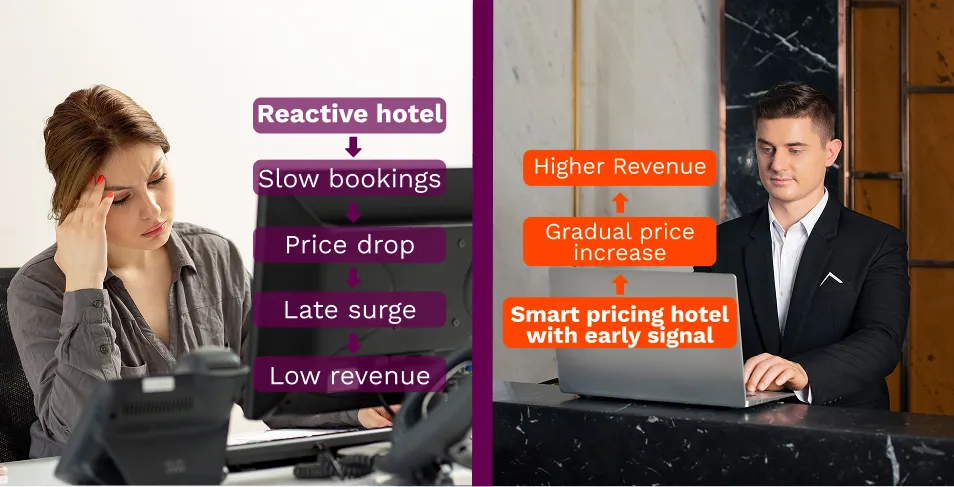
Imagine a standard weekday hotel room rate is $150. Expecting low demand, you drop to $130, then $110. A last-minute corporate event drives bookings, but your remaining rooms sell at discounted rates. You fill occupancy, but lose revenue. Most of those rooms went at lower prices.
If you had increased rates as soon as booking pace picked up, you could have earned significantly more from the same inventory. Instead, demand showed up before your pricing did. And once those rooms are sold, there’s no way to recover that lost revenue. This shows that full occupancy at static or reduced rates does not mean higher revenue. That gap is exactly why dynamic pricing matters.
“Dynamic pricing helps you maximize revenue in real time, protect margins, and optimize inventory by adjusting rates based on demand, competition, and guest behavior,” explains our Chief Revenue Officer, Maria Valiente. It improves forecasting, balances occupancy, boosts RevPAR, and keeps you ahead by enabling faster, more informed pricing decisions instead of reactive changes. Research shows that with the right pricing strategy, hotels see an average RevPAR increase of 21%, delivering a return on investment of more than 50 times the monthly cost of the tool.
Now the trend is to move from set-and-forget pricing to consistently monitoring demand and responding before the opportunity is gone.\
What Actually Drives Your Room Price
In the example, the problem wasn’t just timing. It was missing the signals that were already there. Pricing is never driven by one factor.
Start with demand and seasonality. Weekends, events, and holidays naturally push prices up. But as you saw, demand doesn’t always show up where you expect it. A “slow week” can turn into a high-demand period overnight.
Then comes inventory. The fewer rooms you have left, the more pricing power you gain. In your case, as bookings picked up, that was the moment to increase rates. Instead, prices stayed low while availability dropped.
Now look at the booking window. Early bookings and last-minute demand behave differently. If bookings are slow early on, it doesn’t always mean demand is weak. Sometimes it just hasn’t arrived yet. Dropping prices too soon can cost you later. In our example, early in the week, demand looked weak. Selling rooms at lower rates meant you filled rooms before higher-paying customers showed up.
Competitor pricing and market trends matter, but only as a reference. Following competitors blindly often leads to the same mistake: reacting late instead of acting early.
Then guest segments influence how much people are willing to pay. Business travelers, last-minute bookers, or guests coming from different countries all behave differently. Pricing should reflect that, not treat every booking the same. The best case is our example because business travelers are typically less price-sensitive. If the room rate was $240 instead of $150, many would still have booked because they needed the room.
On top of that OTA commissions, campaigns, promotions, and loyalty programs all affect your net revenue. This is why tactics like length-of-stay pricing (discounting longer stays), geo-based pricing, last-minute pricing (raising or lowering rates based on remaining inventory) exist.
Only to sell the right room, to the right guest, at the right price, at the right time.
When Should You Change Your Price?
Stop looking only at occupancy, what matters is booking pace, how fast rooms are being booked compared to what you expected. If bookings are coming in faster than usual, that’s your signal to increase rates early. Consider the earlier example, once corporate demand started picking up midweek, that was the moment to push prices up, not after you were nearly sold out.
If bookings are slower than expected, instead of last-minute panic discounting, make smaller, earlier adjustments to stimulate demand without damaging your overall rates. This is where booking curves help. They show how demand typically builds over time. When your current pace deviates, faster or slower, it’s a clear signal to act.
Events make this even more time-sensitive. For major events, peak rates often appear around 110 days before arrival, while another surge can happen 10–14 days before check-in, as per HospitalityNet. That means pricing decisions need to happen in phases, early adjustments when demand signals first appear, and later adjustments as bookings accelerate or change.
“Simply, pricing is not a one-time decision. It’s a series of timed moves based on how demand is unfolding,” states Maria. That’s where the right systems and tools make the difference, helping you read these shifts early and act with confidence, not guesswork.
How our Dharma OPS-PMS Tech Stack Helps You with Dynamic Pricing
All of this only works if you can actually see what’s happening, clearly and in time. Check out how our OPS + our PMS combination helps you with the right price and the right time.
All data in one place: Our PMS brings a unified view of all bookings, availability, and guest data. Instead of switching between systems, you get a unified view of reservations, booking pace, occupancy, upcoming check-ins, and gaps as they happen.
Clear demand signals: You can see which room types are selling faster and which are lagging, so pricing decisions are not blanket changes but more targeted. At the same time, guest inquiries, booking intent, and communication patterns give early signals of demand before it fully shows up in occupancy.
Real-time decision making: With live dashboards and graphical performance reports that refresh with every booking received, you’re responding to what is happening now. Combined with flexible rate plan management, you have the ability to adjust pricing quickly based on multiple rate plans, discounts, and pricing structures.
Smarter, higher-value pricing: Moreover, with guest profiles you can understand past behavior and segments. You price more intelligently and capture higher-value bookings, not just more bookings.
The difference between average and high-performing hotels is not occupancy, it’s how well they read and act on demand. With the right visibility, pricing becomes a confident decision, not a constant guess. Want to know more about how Dharma Tech can help you make such confident decisions? Book a demo.