

If you're running more than one property from a laptop right now, you already know the real question isn't “Should I go remote.” You're already remote. The question is what actually holds up when you're not standing in the lobby.
Local labor costs are climbing, local talent is tough to retain, and trying to handle every check-in, maintenance emergency, and late-night guest text in-house leads to classic operator burnout. Worse, as your property count grows, quality decays.
When looking to scale remotely, operators often face a major question: Is the answer pure software automation, full-service outsourcing, or a hybrid of both, and what actually determines the right mix for your portfolio?
When Should You Outsource Remote Hospitality Management
There is no magic property count at which every operator should outsource. The better trigger is operational complexity.
You may be ready to outsource when:
- You are spending more time coordinating operations than growing the business.
- Guest response times are slipping.
- You are constantly chasing cleaners, maintenance vendors, or contractors.
- You have properties in markets you cannot easily visit or are managing multiple time zones.
- A property can no longer operate smoothly when you take a day off because you are becoming the escalation point for every small problem.
That last one is particularly important. If every operational decision still ends up with you, you have not really built a remote business. You have built a business that happens to be operated from a distance.
The Software-Only Approach to Remote Property Management
Software can now handle much of your remote operation: a PMS keeps bookings synchronized, smart locks enable self-check-in, AI manages routine guest messages, and dynamic pricing tools adjust rates based on demand.
The biggest advantage is cost control and consistency. Software costs are generally tied to your property count or usage, rather than taking a percentage of your growing revenue.
But software has limits. It cannot repair a broken AC, resolve a difficult guest dispute, inspect a property, or build relationships with local vendors.
For that reason, software-only management works best for tech-comfortable operators with a small portfolio in one market, particularly simpler STRs and boutique properties with reliable local support.
The Full Outsourcing Approach: Traditional Property Management Companies
The other option is to hand most of the operation to a traditional property management company or local operator. This is still a very sensible model.
You pay someone else to handle the day-to-day work, and they take responsibility for things such as guest communication, reservations, housekeeping, maintenance coordination, or local vendors.
The biggest advantage is you don't have to build all of this yourself. Especially if you are entering an unfamiliar market, managing a high-touch property, or simply want to be completely hands-off, that can be worth a lot.
But this comes at a price. For vacation rentals, full-service management commonly falls around 20% to 35% of gross rental revenue, depending on the market and what is included. Lower-cost models may handle only the digital side of the operation while leaving cleaning and physical operations to the owner or local team.
That percentage matters more as your business scales, and this is why some operators ask, “Do I really need to outsource every task to justify outsourcing the tasks I can't do remotely?”
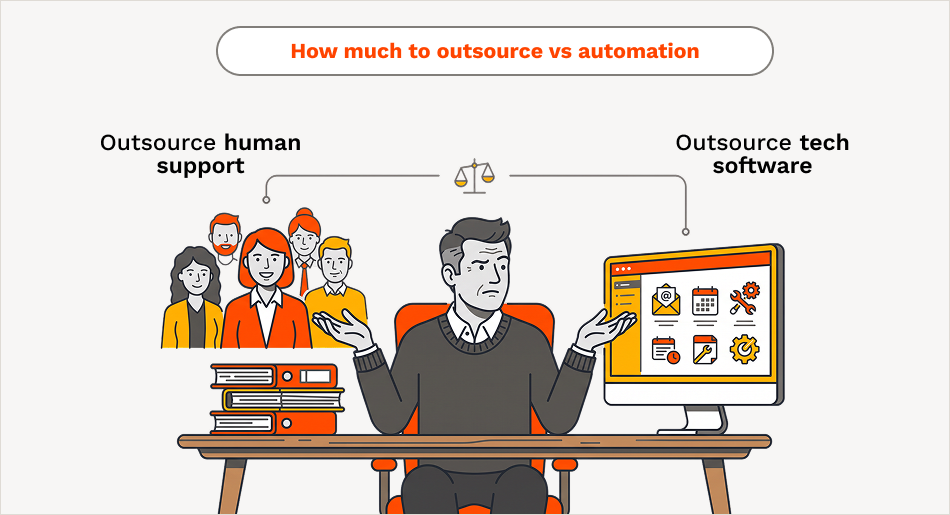
The Hybrid Model: Why Most Successful Remote Operators Land Here
Here’s the third interesting approach. Instead of asking software or people to run the entire business, you divide the operation into three categories:
Automate repetitive tasks: guest FAQs, reservation confirmations, check-in instructions, calendar updates, pricing changes, review requests, and routine notifications.
Outsource physical work: cleaning, inspections, restocking, repairs, emergency response, vendor coordination, and property visits.
Keep strategic decisions in-house: brand standards, revenue strategy, owner relationships, quality benchmarks, financial oversight, and expansion decisions.
This is the hybrid operating model where software handles repeatable digital work, while people handle work requiring judgment or physical presence. The goal isn't to eliminate team members. It is to use your staff where they add value, and software where it can reliably do the job.
A useful way to decide about what to outsource and what to automate is to ask: Does this task require local presence, specialized expertise, or human judgment? If the answer is yes, outsourcing may make sense. If the task is repetitive and rules-based, automate it first.
The key is to outsource the right task.
Hidden Risks of Full Outsourcing
There are some important factors to consider for the hybrid model because outsourcing can remove operational headaches. But it can also create a different kind of risk.
If your property manager handles everything through its systems, you may know that the problem was "resolved" without knowing how, how quickly, or whether it will happen again.
That becomes particularly uncomfortable when you are managing a growing portfolio.
1. You lose operational visibility
2. Communication becomes fragmented
3. Your costs scale with revenue, as a percentage-based management fee can become increasingly expensive with an increasing portfolio.
4. Quality becomes difficult to audit
You may see your review score. But do you know how many maintenance requests were overdue? How long did they take to resolve? How many cleaning issues were reported? How often did guests need to follow up?
Those operational metrics matter. And the right software helps you keep track of these metrics while making them standardized.
Why The Dharma’s Hybrid Model: Combining Remote Service Management + Tech Stack
This is the model Dharma is built around.
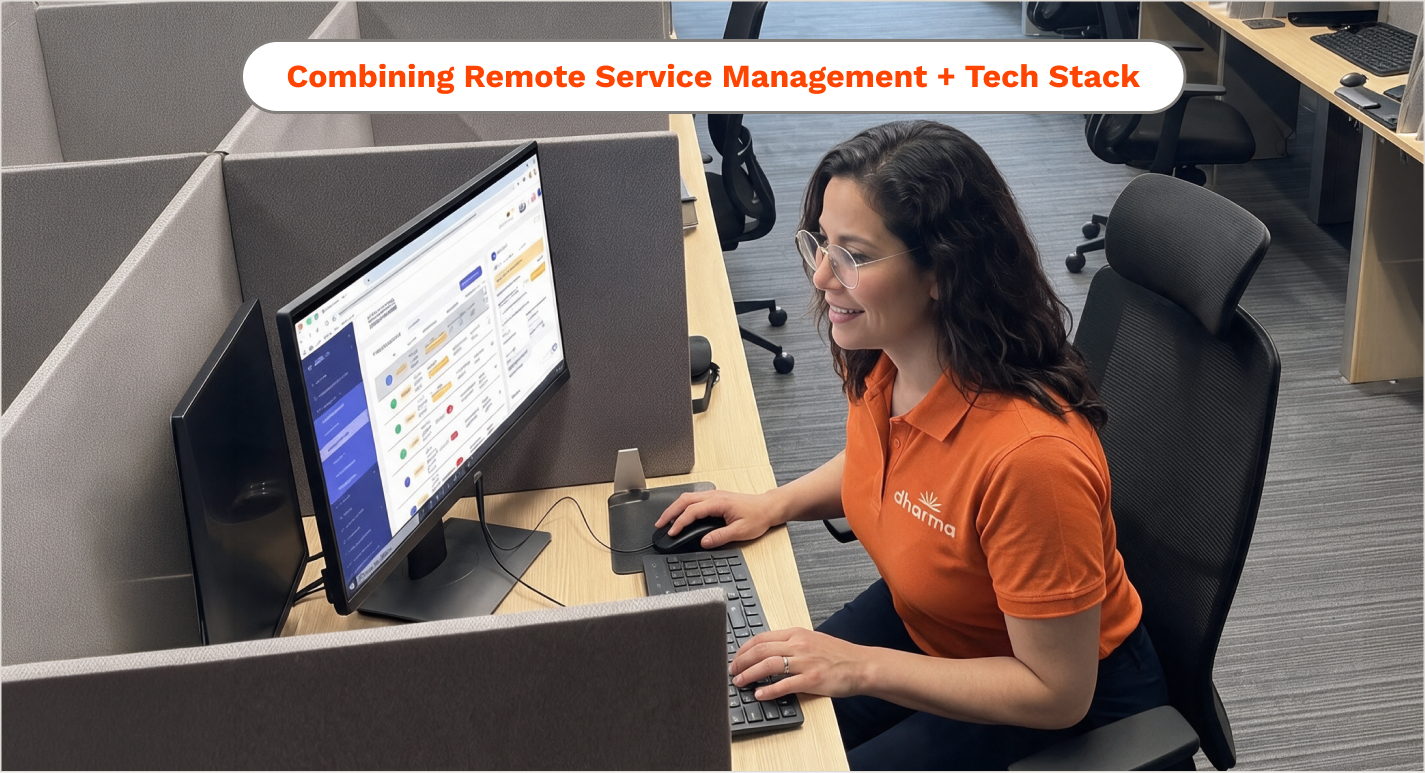
Dharma's Full Remote Service Management is designed to act as the operational execution layer, handling day-to-day activities such as guest communication, reservations, housekeeping coordination, and maintenance follow-up. Behind that service is Dharma OPS + PMS, which provides the channel management, operational system for managing calendars, reservations, cleaning, maintenance, guest communication, and work orders.
The idea is to connect the remote people doing the work with the operational information they need to do it. Let’s consider our Dharma Home Suites example:
Imagine a guest checking out of a unit. The OPS records the departure and automatically assigns housekeeping. During cleaning, the team discovers a faulty appliance and creates a work order. The remote operations team can assign it to a maintenance partner, track progress, and update the unit status. Meanwhile, the guest-facing team can see whether the property is ready for the next arrival. The owner does not need to coordinate each step.
That is the value of combining remote service management with an operations platform: people manage the work, while software keeps everyone aligned.
The Best Remote Hospitality Model Isn't About Removing People
Technology should not replace the human side of hospitality. It should remove repetitive work so your team can focus on guests, properties, owners, and decisions that require judgment.
The strongest remote model combines human service with operational orchestration, giving your team the right tools without losing the human layer.
The question is: Which parts of your operation should be automated, which should be handled remotely, and where do you still need people on the ground?
Call us to find the right operating model for your business, and let’s build a more efficient operation that helps you grow your properties profitably.