
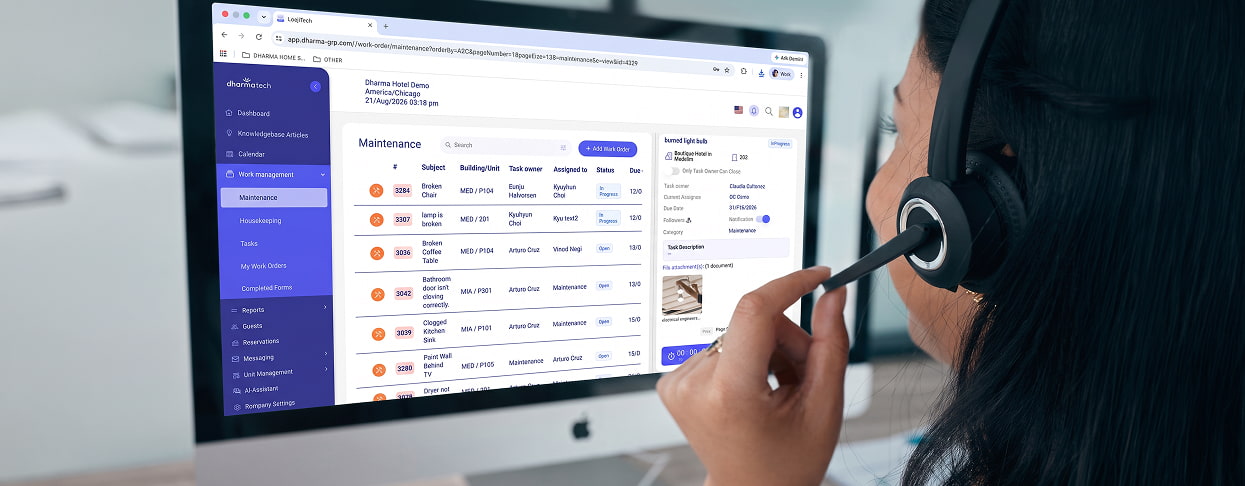
Running a property is rarely about one big task. There are dozens of small tasks happening at the same time. For a small portfolio, an in-house team may be able to keep up. But as the number of properties grows, the workload grows with it. Hiring more people for every operational function is not always practical, especially as hospitality businesses deal with ongoing labor shortages, rising wages, and increasingly demanding guest expectations.
At the same time, guests expect fast answers, smooth digital check-ins, clean properties, and quick resolution when something goes wrong. This is where remote property management comes in.
Instead of hiring a large in-house team to manage every operational task, property owners and operators can outsource specific functions to a remote team supported by the right technology. And this blog will help you understand everything about remote hospitality management as a service.
What Is Remote Property Management, Exactly?
Remote property management means outsourcing specific property management and operational responsibilities to an external team working remotely. Unlike a virtual assistant
handling miscellaneous administrative tasks, remote management follows defined workflows, SOPs, escalation rules, technology systems, and performance standards.
Think of it as an extension of your operations team, with different possible service models:
- Fully outsourced: An external team manages your operational functions like guest communication, housekeeping management, revenue/pricing etc. from end to end.
- Hybrid: Your internal team retains strategic or high-value responsibilities while a remote team handles recurring operational work.
In many cases, operators can keep their local teams while outsourcing guest communication and coordination. Your underlying tech such as your PMS, work-order systems, smart access, dashboards, and knowledge base connect remote and on-site teams.
Remote Hospitality Operations vs. Traditional Property Management
Remote hospitality operations do not replace property management. They change how operational work gets done, allowing physical teams to stay on-site (or travel between distributed properties) while coordination, communication, and monitoring happen remotely.
In a traditional model, property managers often handle everything themselves: answering guests, coordinating cleaners, calling vendors, following up on maintenance, managing reservations, and preparing reports. As the portfolio grows, they become the connection point for every task.
A remote operations model separates physical work from operational coordination.
- Guest communication: A remote team handles inquiries, check-in information, guest requests, and after-hours communication while maintaining consistent responses.
- Housekeeping: Cleaners still work on-site, but remote teams schedule turnovers, assign tasks, track completion, and flag delays.
- Maintenance: Technicians handle repairs on-site, while remote teams receive requests, create work orders, coordinate vendors and access, and follow up until completion.
- Administration: Remote teams can manage vendor communication, supplies, reservations, documentation, and recurring reports.
- Monitoring: Technology gives remote teams visibility into issues such as access problems, device alerts, and operational exceptions.
- Reporting: Instead of piecing information together from different people, managers get a consolidated view of work orders, housekeeping, guest issues, and outstanding tasks.
The benefit is not simply having another team answering messages. It is having someone responsible for making sure operational tasks move from request to completion without the property manager having to coordinate every handoff.
.jpg)
Why Properties Choose Remote Management?
Remote management becomes valuable when a property's growth, workload, or service expectations start exceeding what the existing team can handle.
- Growth outpaces the team: Add more properties without increasing local headcount at the same rate.
- Finding the right talent is difficult: In remote destinations, resorts and hotels may struggle to find qualified local staff and often have to work with a limited talent pool.
- Labor costs affect margins: Get operational capacity without the full cost and management burden of building an in-house team.
- Teams are burning out: Take repetitive guest communication, housekeeping coordination, and follow-ups off managers' plates.
- Response times matter: Provide consistent guest support beyond normal working hours.
- You need to scale: Combine remote teams and technology to handle more operational work without proportionally increasing headcount.
For operators with local teams, remote services connect the people and processes to keep operations running smoothly.
Which Properties Should Consider Remote Services?
Remote services work best for properties where operations are growing faster than the local team can handle. They are especially valuable for properties with lean teams, multiple buildings or units, extended hours, staffing challenges, or operations spread across locations. For properties like:
- Branded Residences
- Resorts & Lifestyle Resorts
- Independent Hotel Groups
- Serviced Apartments / Aparthotels
- Corporate Housing Operators
- Boutique Hotels
- Real Estate Developers & Property Owners
The common thread is simple: the physical work still needs to happen on-site, but much of the coordination, communication, monitoring, and follow-up doesn't. Remote services help these properties maintain consistent service without building a large local operations team.
Can You Trust a Remote Team With Your Operations?
For many operators, the real question is not “Can someone answer my guest messages?” but “Can I trust someone who is not physically here to manage part of my operation?”
And it depends on your clear processes and structure. Here’s how:
- SOPs create consistency: Clear procedures tell the team how to handle common situations, from guest requests and housekeeping coordination to maintenance issues and escalation.
- Escalation rules protect the operator: Remote teams can handle routine questions, scheduling, follow-ups, and predefined issues, while operators retain decisions involving major refunds, owner relationships, strategic vendors, or significant incidents.
- Reporting creates visibility: Operators should be able to see guest response times, open work orders, housekeeping completion, recurring issues, and escalations without constantly checking in with the remote team.
- Benchmarks make performance measurable: Useful metrics include response time, work-order completion, housekeeping completion, escalation response, and unresolved tasks.
This gives the operator operational control without requiring them to personally oversee every guest message, housekeeping update, or maintenance follow-up.
How Dharma Combines Remote Service Management + Tech Stack to Eliminate Bottlenecks
Dharma combines Remote Service Management with Dharma OPS because software can organize information, but people are still needed to act on what happens in real time.
Dharma OPS brings property information, guest communication, tasks, workflows, and operational knowledge into one shared system. The remote team then uses that information to coordinate the work.
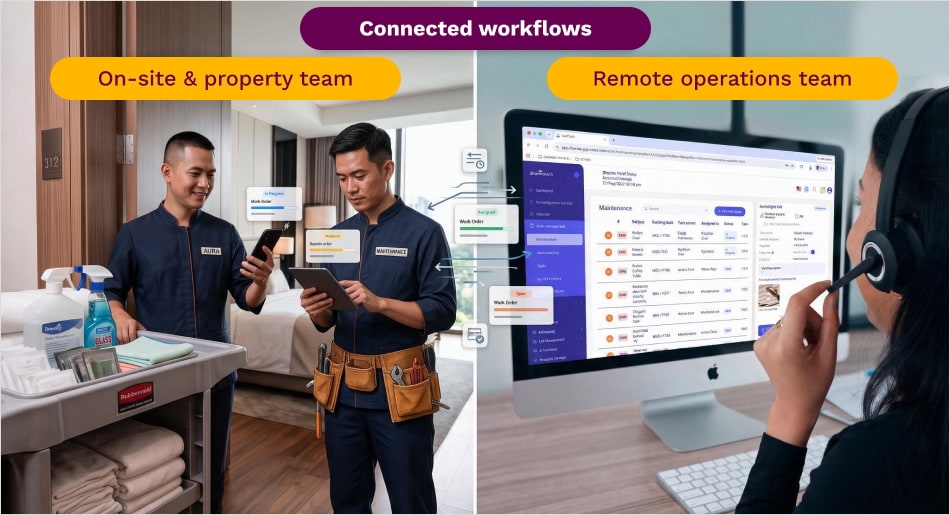
For example, when a guest reports a maintenance issue, the workflow can move from guest request → work order → vendor assignment → progress tracking → resolution → guest update. This reduces the manual handoffs that can cause tasks to get lost between teams.
But technology alone is not enough. Remote teams also need access to property-specific SOPs, guest information, brand guidelines, escalation rules, and the decisions they can make independently. That combination is what makes remote operations work: technology provides visibility and structure, while trained people handle coordination and execution.
Important Points To Consider Before Outsourcing
Remote services can take significant operational work off your team's plate, but not everything should or can be outsourced.
- Physical work stays on-site: Housekeeping, maintenance, inspections, and inventory management still require people at the property.
- Business decisions stay with you: Owners and operators remain responsible for strategy, budgets, major vendor decisions, owner relationships, and other important business decisions.
- Ready to see what remote property management could handle for your business? Explore how Dharma combines remote operations and technology to keep your properties running smoothly, wherever your team is.
- Build the right foundation: Clear SOPs, workflows, property information, communication channels, and escalation rules make remote teams much more effective.
- Use proven technology to connect everything: The right systems give remote teams the information and visibility they need to coordinate operations efficiently.
Ready to see what remote property management could handle for your business? Explore how Dharma combines remote operations and technology to keep your properties running smoothly, wherever your team is.