
The hospitality industry is entering a new era. Nearly one in three travelers stayed in an alternative accommodation at least once in 2024. This shows, traditional accommodation categories are becoming harder to define as travelers increasingly prioritize experience, flexibility, space, and convenience over whether a property is labeled a hotel, serviced apartment, or vacation rental.
And the shift is significant. The global alternative accommodation market was valued at USD 133.2 billion in 2023 and is projected to grow at a CAGR of 15.5%.
Travel has become less about simply finding a room and more about finding the right experience. This shift is driving what many operators now call hybrid hospitality.
What Is Hybrid Hospitality?
Hybrid hospitality refers to businesses that operate multiple lodging models under one brand or management structure. These may include hotels, serviced apartments, vacation rentals, aparthotels, co-living spaces,corporate housing, or extended-stay accommodations.
The lines between these categories are becoming increasingly blurred. Today's travelers are less concerned about accommodation type and more focused on finding the best combination of location, value, amenities, space, and convenience.
Major hospitality brands are already adapting by building their portfolio of mixed properties:
- Wyndham entered the residential segment through its partnership with Reside, opening apartment-style properties featuring full kitchens and in-suite laundry.
- Accor continues expanding its hybrid strategy through Accor One Living and Adagio, combining residences, serviced apartments, coworking, wellness, and hospitality services under a single ecosystem.
- Hilton has expanded its extended-stay footprint through Home2 Suites.
- Choice Hotels reported 10.8% year-over-year growth in its domestic extended-stay portfolio in early 2025.
The message is clear: hospitality brands increasingly see value in serving multiple stay types rather than operating within a single category.
Why Hybrid Hospitality Is Growing So Quickly?
Guests are looking for accommodations that become part of the trip itself rather than simply a place to sleep. Here are several long-term trends that are accelerating this convergence:
- Experience-Driven Travel: Travelers increasingly prioritize unique and memorable experiences over traditional accommodation categories. According to Accor’s 2026 travel trends, you can see, experiences are becoming a key driver of booking decisions, particularly among younger travelers.
- Guests Want the Comfort of Home: Many travelers want the best of both worlds: the reliability and service of a hotel combined with the space and comfort of home. Features such as kitchens, separate living areas, laundry facilities, and additional space are increasingly important for families, remote workers, long-stay guests, and multi-generational travelers.
- Wellness, Sustainability, and Lifestyle Preferences: Travel decisions are increasingly shaped by lifestyle priorities. Guests are looking for wellness amenities, healthier environments, outdoor experiences, sustainable operations, and pet-friendly accommodations.
- Bleisure Travel: Remote work fundamentally changed travel behavior. Travelers increasingly combine business and leisure trips, creating demand for accommodations that support both work and lifestyle needs.
- Demand for Flexibility: Modern travelers want options for self-check-in, flexible arrival times, extended stays, customized services, and varying levels of interaction with staff. Hybrid hospitality models allow operators to cater to these different preferences more effectively than traditional accommodation models built around a single guest journey.

4. Bleisure Travel: Remote work fundamentally changed travel behavior. Travelers increasingly combine business and leisure trips, creating demand for accommodations that support both work and lifestyle needs.
5. Demand for Flexibility: Modern travelers want options for self-check-in, flexible arrival times, extended stays, customized services, and varying levels of interaction with staff. Hybrid hospitality models allow operators to cater to these different preferences more effectively than traditional accommodation models built around a single guest journey.
What Hybrid Hospitality Means for Property Operators
While guests enjoy greater flexibility, operators face a much more complex business environment.
Competition Is No Longer Limited to Hotels
A city-center hotel is no longer competing only with nearby hotels. For guests all of the stay options often appear side by side on the same booking platforms. The scale of this competition is substantial. If you look at Airbnb growth, it now has more than 8 million listings worldwide and its share of the business travel market increased from 28% in 2019 to 44% in 2024.
Guest Expectations Are Rising Everywhere
Guests no longer have separate expectations by accommodation category. A traveler who enjoys mobile check-in, instant messaging, flexible stays, or personalized recommendations at a vacation rental expects similar convenience from a hotel.
Hybrid Hospitality Creates Operational Complexity
Managing a mix of hotel rooms, serviced apartments, and extended-stay units introduces operational challenges traditional hotel models were not designed to handle. Here are they:
- Housekeeping: A one-night hotel stay requires a full room turnover, while a 30-night corporate stay may require weekly cleaning, periodic deep cleans, and different inspection schedules. Managing these varying service frequencies across multiple unit types makes scheduling, staff allocation, and quality control significantly more complex.
- Guest Communication: Leisure travelers, business travelers, digital nomads, and long-stay guests all require different communication journeys and service expectations. Communication to each traveler without increasing manual load requires strategic operational support.
- Maintenance: Full kitchens, laundry equipment, smart access systems, and residential-style amenities create maintenance demands that are closer to residential property management than traditional hotel operations. A single issue may involve guest communication, contractor coordination, owner updates, cost tracking, and work order management. Operators need centralized systems that connect maintenance requests, team coordination, guest updates, and reporting in one workflow.
- Inventory Management: Hotels typically sell room types, while serviced apartments and vacation rentals are often sold as individual units. Managing both inventory models simultaneously can create operational complexity, particularly when availability, pricing, and stay restrictions need to be coordinated across multiple channels.
- Reporting and Visibility: Hotel rooms, serviced apartments, and vacation rentals often operate in separate systems with different reporting structures. As a result, operators may struggle to compare performance, identify profitable inventory types, understand operational costs, or spot underperforming assets. Without a unified view, making informed revenue and investment decisions becomes much harder.
- Owner and Asset Management: Properties with serviced apartments or managed rental inventory often involve owner relationships that traditional hotels do not have. Tracking owner communications, unit performance, maintenance costs, and operational responsibilities adds another layer of complexity.
Why Technology Has Become the Competitive Advantage
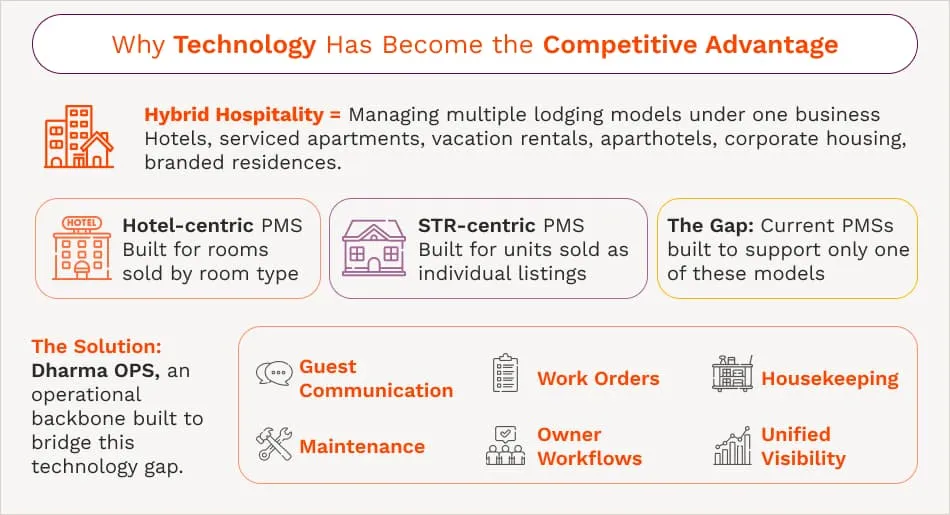
A hybrid operator simultaneously manages one-night transient stays, weekly extended stays, or even monthly corporate housing agreements — all across multiple channels, guest types, and inventory models.
Therefore, hybrid hospitality creates operational gaps that traditional hotel or vacation rental systems cannot fully solve. As highlighted earlier, operators face multiple challenges such as different inventory logic, inconsistent guest and stay data, disconnected operations, fragmented owner and asset management, limited reporting across mixed models, and manual duplicate processes.
One of the biggest challenges lies in how different accommodation models are managed and distributed. Traditional hotel PMS platforms are designed for rooms sold by room types with room categories, revenue management, and guest services. Vacation rental PMS platforms are designed for units sold by individual listings with unit-level calendars, owner relationships, and distribution to channels such as Airbnb and Vrbo.
Technology becomes a competitive advantage when it bridges these gaps. Connected systems bring together different room/unit types, guest communication, housekeeping,
maintenance, work orders, owner workflows, and reporting into a single operational ecosystem.
Right Tech Implementation Will Shape Your Success
Hybrid hospitality is already reshaping how accommodation businesses compete. For guests, the operational complexity behind these models is invisible. They simply expect a seamless stay.
For operators, however, managing different inventory types, guest journeys, housekeeping workflows, maintenance needs, and communication processes is becoming increasingly complex.
This is why technology has become a competitive advantage. Hybrid hospitality demands hybrid technology like Dharma OPS. Discover how our OPS serves as the operational backbone for hybrid hospitality, working alongside your existing tech stack — without replacing the systems you already use.