
Guest communication is no longer simple.
Today, every stage of the guest journey has become both a communication and operational task. A potential guest may ask questions through an OTA before booking, request early check-in through WhatsApp, submit maintenance requests through a guest app, and expect personalized follow-ups after checkout.
For operators managing hotels, vacation rentals, serviced apartments, and extended stays, communication can happen anytime, anywhere.
Guest expectations continue to rise alongside this complexity. Global guest satisfaction reached 86.7% in 2025, based on over 40 million reviews as per Shiji’s Guest Experience Benchmark Report. To meet this growing benchmark, properties need connected, automated communication workflows across the entire guest journey, not just during pre-booking and check-in.
By the end of this post, you’ll see exactly where communication tends to break down, and how Dharma’s tools turn every guest touchpoint into a smooth, automated workflow. Let’s dive in.
Understanding the Guest Journey: Where Communication Opportunities Are Still Being Missed
Guest communication doesn’t begin at check-in, nor does it end at checkout. The guest journey is a continuous cycle, and every stage presents an opportunity to improve the guest experience, reduce operational pressure, and build lasting loyalty.
.jpg)
Phase 1: Pre-Booking
Communication begins long before a reservation exists. Potential guests often have questions that directly influence their booking decision: Which property suits my needs? Is parking available? Can I bring my pet? Do you accommodate long stays? Is the property suitable for families?
These inquiries may seem simple, but response quality and speed often determines conversion rates. A delayed or inconsistent reply can easily cost you a reservation. Many operators have already introduced AI chatbots and communication automation at this stage, but these systems often struggle to deliver consistent experiences across hybrid portfolios and more complex guest scenarios.
For example, imagine helping a traveler choose between your boutique hotel room and a serviced apartment. This requires different conversations to understand what they actually need. Each property type comes with different amenities, pricing structures, services, and each demands its own communication workflow and SOPs. This is exactly where Dharma’s AI chatbot earns its keep: it’s built to flex across property types and guide each guest toward the right answer, instantly.
Phase 2: Post-Booking to Arrival
This is where operators tend to already have some automation in place: booking confirmations, check-in reminders, and pre-arrival emails have become fairly standard. Even so, communication often remains fragmented. Arrival instructions may come from one system, agreements from another, and parking information only after a guest reaches out manually.
When these pieces live in disconnected systems, teams quickly become overwhelmed by repetitive requests. Questions about WiFi, parking, arrival times, and access codes can eat up every single week, time your team could be spending on guests who actually need a human touch.
Phase 3: During Stay
This is where communication gaps become most visible. The issue usually isn't receiving a request for towels, maintenance, or a housekeeping change. It's everything that happens afterwards. Was the request assigned? Was the guest updated? Most guest frustrations come from how an issue is resolved, not from the fact that an issue came up at all.
For hybrid operators running multiple property types, this gets even harder. Each property type needs its own workflow, and without connected systems consistent communication and service coordination become extremely difficult. Dharma's Operations Platform (OPS) was built precisely for this: every guest request automatically becomes a tracked ticket, routed to the right team member, so nothing falls through the cracks.
Phase 4: Post-Stay
Communication should not stop the moment a guest checks out. The post-stay phase is one of your best opportunities to collect valuable feedback, generate reviews, resolve concerns privately, encourage repeat bookings, and build long-term loyalty. Unfortunately, many operators treat this stage as an afterthought. Review requests are forgotten, guest feedback goes unread — future booking opportunities quietly disappear.
Most operators heavily automate Phase 2. Phases 1 and 3 remain largely manual despite having some of the largest impacts on guest satisfaction. Every phase holds real communication opportunities. The challenge is knowing which interactions should stay personal and which ones are ready to be standardized and automated.
Building an End-to-End Guest Communication Automation Workflow
Guest communication should function as one continuous operational workflow rather than a scattered collection of one-off messages. Here are important aspects of developing a workflow:
- Unified Guest Profile
It starts with a unified guest profile. Every interaction should feed into one centralized record containing booking information, guest preferences, previous stays, communication history, past requests or service issues. This gives your teams the full picture of the guest journey instead of piecing it together from fragmented conversations.
- Identifying Repetitive Queries and Requests
Next, identify the repetitive communication touchpoints that consume staff time. These often include arrival instructions, WiFi information, parking details, access codes, frequently asked questions, maintenance updates, or review requests.
These interactions matter, but they do not all need a human typing out the same answer. This is where trigger-based workflows come in.
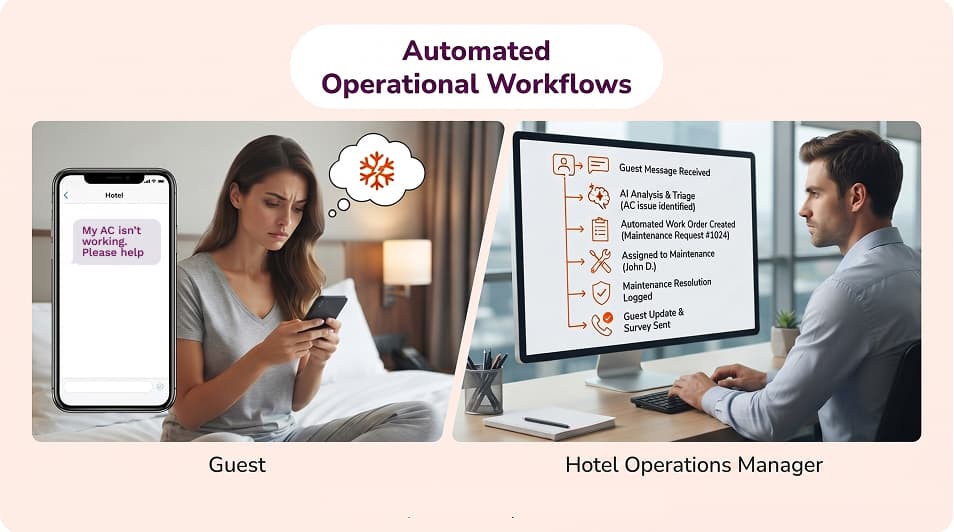
A sample in-stay workflow might look like this:
Guest request → Acknowledgment → Staff assignment →Maintenance work order → Escalation (if needed) → Completion notification
And a post-Stay Workflow triggered the moment a guest checks out:
Checkout →Feedback collection → Review campaign → Rebooking offer → Loyalty initiative
3. Unified Inbox for Omnichannel Communication
Communication also needs to extend across every channel your guests actually use, such as email, SMS, WhatsApp, OTA messaging, and guest apps. Guests increasingly expect to communicate through their preferred platform, not yours. Dharma’s Multichannel Inbox brings all of these conversations into one place, so nothing gets missed and every reply stays timely and consistent.
4. Automated Guest Communication Workflow
But communication alone is not enough. True automation happens when a guest message directly triggers an operational action. A maintenance request should automatically create a work order. A housekeeping request should notify the right staff member. An urgent issue should escalate immediately.
That level of automation depends on connected systems sharing data across PMS, CRM, operations platforms, POS, reputation management, and guest engagement tools. As you expand across property types, your workflows need to adapt based on guest profiles, stay duration, service expectations, and operational complexity.
How Dharma Enables End-to-End Guest Communication Automation
Meeting modern guest expectations requires more than software. It requires communication, operations, and human involvement working together. Dharma's Remote Service Management and After-Hours Guest Support Service help properties stay available across channels while reducing staff workload and maintaining a human touch in guest interactions.
When paired with Dharma OPS and PMS connectivity, these guest interactions become operational workflows rather than isolated messages. Guest information, communication history, preferences, and requests are centralized in one environment, allowing messages to automatically trigger housekeeping tasks, maintenance work orders, staff assignments, escalations, and follow-up communication.
This creates a connected ecosystem where remote guest support, PMS data, and operational workflows work together seamlessly across hotels, vacation rentals, serviced apartments, and extended stays. You get faster responses, better coordination, reduced team burnout, and a consistently better guest experience.
Guest Communication Is Becoming an Operational Advantage
Modern guests do not think about departments or software systems. They simply expect seamless experience and support whenever they need it.
As hospitality operations become more complex, guest communication can no longer function as a set of isolated interactions scattered across different touchpoints. It has to become one continuous operational workflow.
Operators are increasingly recognizing this shift. Industry research found that 39% of hoteliers consider improving operational efficiency as technology's biggest value proposition, while 31% believe its greatest value lies in transforming guest journeys. Both goals depend on the same thing: connected and consistent guest communication across every stage of the journey.
By combining remote guest support, PMS connectivity, AI capabilities, operational workflows, and omnichannel communication into a unified ecosystem, we Dharma make this possible.
Ready to streamline guest communication while reducing operational complexity? Schedule a call with us today to see how Dharma's tools can transform your property into a benchmark of guest satisfaction and operational excellence.