
You've probably felt this one: a guest's check-in time is confirmed from a desk, while the person who actually knows whether the room is ready is out in the field, phone in one pocket, cleaning supplies in the other. If those two don't sync up in time, the guest finds out before the office does.
When your teams are split between remote offices and properties across different locations, WhatsApp, Slack, calls, and spreadsheets can quickly become difficult to manage at scale.
So, how do you keep everyone connected, working from the same information?
This blog exactly answers that. It explores how modern operators can connect field and remote teams to build smoother, more coordinated, and scalable property operations.
Field vs. Remote Office Communication: Real Operational Problems in Hospitality
According to Breezeway’s 2025 State of Work Report, 90.2% of a property operator’s daily work involves coordinating with other people. That tells you how much communication hospitality operations require, especially when task volumes are high and expectations keep rising.
Whether you manage a boutique hotel, serviced apartments, or vacation rentals, the challenge is similar.
These gaps rarely happen because your team isn't working hard. They often come from fragmented tech stacks, disconnected PMS data, and indirect communication channels.
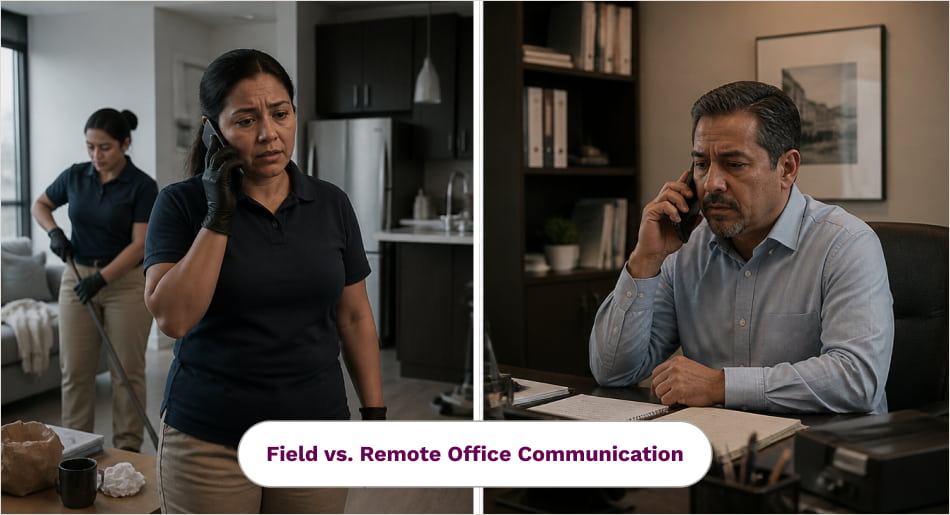
Your PMS knows the booking. Housekeeping knows the room status. Maintenance knows a unit is waiting for a part. But when those systems don't connect, someone has to manually piece everything together, often after a guest notices something is wrong.
What happens when information doesn't travel with the task?
- A room is marked ready when it still needs inspection;
- A maintenance request goes unacknowledged;
- A guest waits for an update while work is already underway;
- Two employees unknowingly handle the same task;
- A remote manager repeatedly chases staff for updates;
- A field employee receives incomplete guest context.
At scale, these friction points create significant operational drag, especially during peak check-in periods.
Benefits of Moving from Reactive to Strategic Communication
Group chats and phone calls may work when you manage five properties. At fifteen, they start to strain. By fifty, keeping track of every task through messages and memory becomes difficult to sustain.
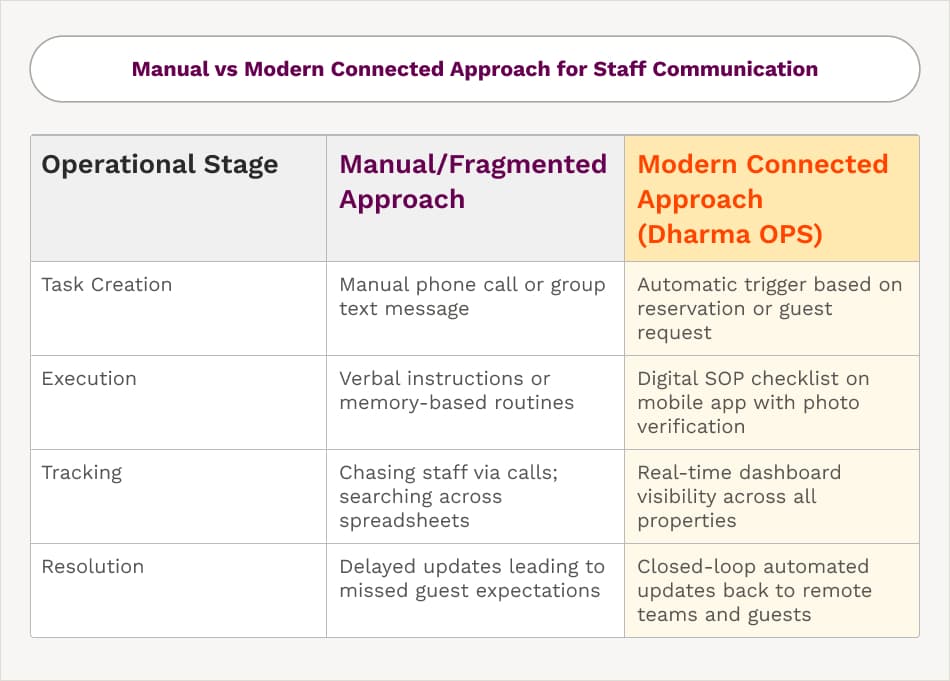
High-performing operators are moving toward contextual, event-driven task automation, where the system creates and routes work as soon as something happens. A guest checks out, and a cleaning task is created. A maintenance ticket remains unacknowledged, and it escalates automatically.
Digital SOPs, mobile apps, and automated work order routing are also becoming increasingly important for operators managing distributed teams. That's why we built Dharma Services alongside Dharma OPS and a mobile app: to connect task assignments with property locations, guest arrival windows, and operational priorities.
Key advantages of connected workflows:
- Automated Escalation: If a maintenance ticket in an occupied unit remains unacknowledged for 20 minutes, the system can escalate it to the appropriate manager.
- Reduced Administrative Tracking: Automating task creation, assignment, and tracking frees your team to focus on guest care. McKinsey reports that nearly 60% of occupations have at least 30% of activities that can be automated, particularly repetitive tasks.
- Standardized Operational Quality: Digital SOPs embedded into work orders help field teams follow consistent processes through mobile checklists, whether it's a quiet Tuesday or a busy weekend.
- One Centralized Database: A shared database gives your teams the same view of each guest's booking history, preferences, requests, and interactions. When a guest returns, your team doesn't have to start from zero. They can recognize their preferences and deliver a more personalized experience.
- 24/7 Guest Service: AI can handle routine guest questions and requests around the clock, while your remote service team steps in when human judgment or intervention is needed. Because everyone works from shared operational data, guests receive more consistent and informed support.
How to Coordinate Field Staff and Remote Office Teams
To move from constant firefighting to smoother operations, your field and remote teams need shared visibility, clear ownership, and connected workflows. Here’s how to achieve that:
- Create a single operational source of truth. Every task should include the property and unit, task type, priority, assigned staff member, status, deadline, and relevant guest context. If this information lives across five different places, it becomes difficult for anyone to see the full picture.
- Connect guest requests directly to field tasks. A broken AC or late checkout shouldn't pass through three people before becoming a work order. Fewer manual handoffs mean fewer opportunities for information to get lost.
- Give field staff simple visibility. Your cleaners and technicians need to know what needs to be done, where, by when, and why. They don't need the entire guest conversation to complete the task correctly.
- Give remote teams real-time visibility. Assigned, pending, in progress, completed, or escalated: your office team should see task status without constantly calling the property.
- Automate escalations. If a task remains unassigned, unacknowledged, or unresolved beyond a reasonable window, the system should flag it before the guest does.
- Close the loop automatically. When a cleaner marks a room “Inspected & Ready,” that status should immediately reach the remote team and trigger the next step in the guest workflow.
The workflow is simple: Guest request → Task creation → Staff assignment → Field execution → Status update → Guest communication.
Connect those steps, and phone calls become the rare exception rather than the constant routine.
Automated Workflows, Stronger Teams
Your field and remote teams don't need more messages. They need to see the same picture and know exactly what needs to happen next. When guest requests, task assignments, field execution, status updates, escalations, and guest communication work as one connected workflow, your teams spend less time chasing information and more time getting the work done.
That's what we built Dharma to solve. Dharma combines Remote Service Management with Dharma OPS, along with a mobile operations platform that keeps on-site teams connected to the remote team and the work happening across your properties. Your field team gets clear tasks and context, while your remote team gets the visibility they need without constantly asking for updates.
Dharma OPS doesn't replace your team. It empowers them to work better together.
Ready to eliminate communication silos? Book a call with our team to see how Dharma can help your property teams stay connected, coordinated, and in sync.