
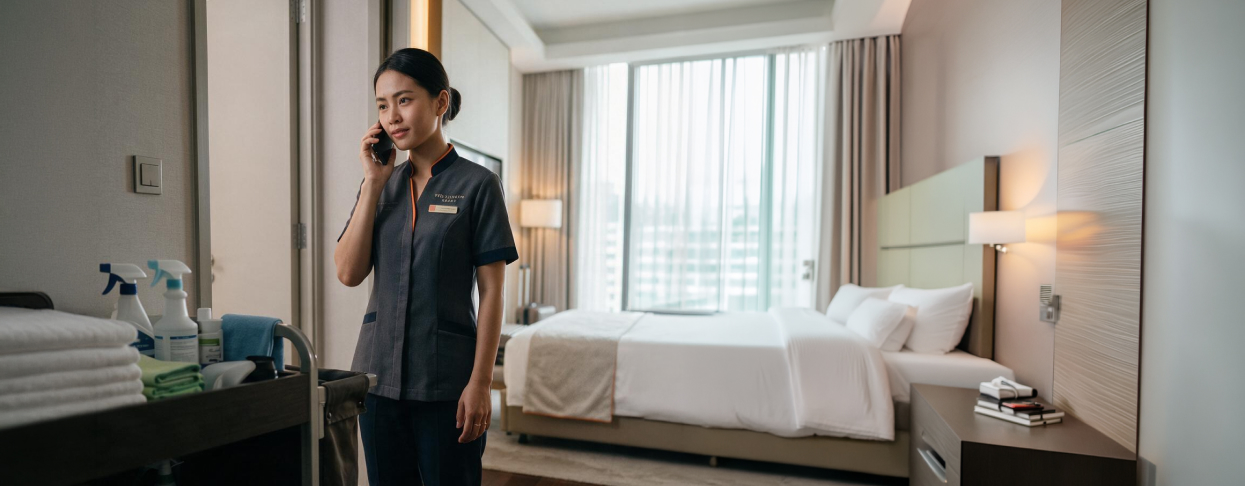
Over the last few months, AI has made building simple tools or softwares easier than ever. The rise of no-code platforms and concepts like “vibe coding” have created the impression that any operator can now build custom automations for everyday tasks.
But while automating a few isolated activities may be simple, hospitality operations are uniquely volatile. Housekeeping schedules change constantly based on arrivals, departures, maintenance emergencies, and staffing shifts.
Workflow automation isn’t just about triggering a single notification. It requires syncing task creation, digital SOPs, mobile workflows, and cross-system communication.
The good news is that this does not require a costly, painful replacement of your PMS. Instead, the right automation layer can work alongside your existing tech stacks to streamline day-to-day operations.
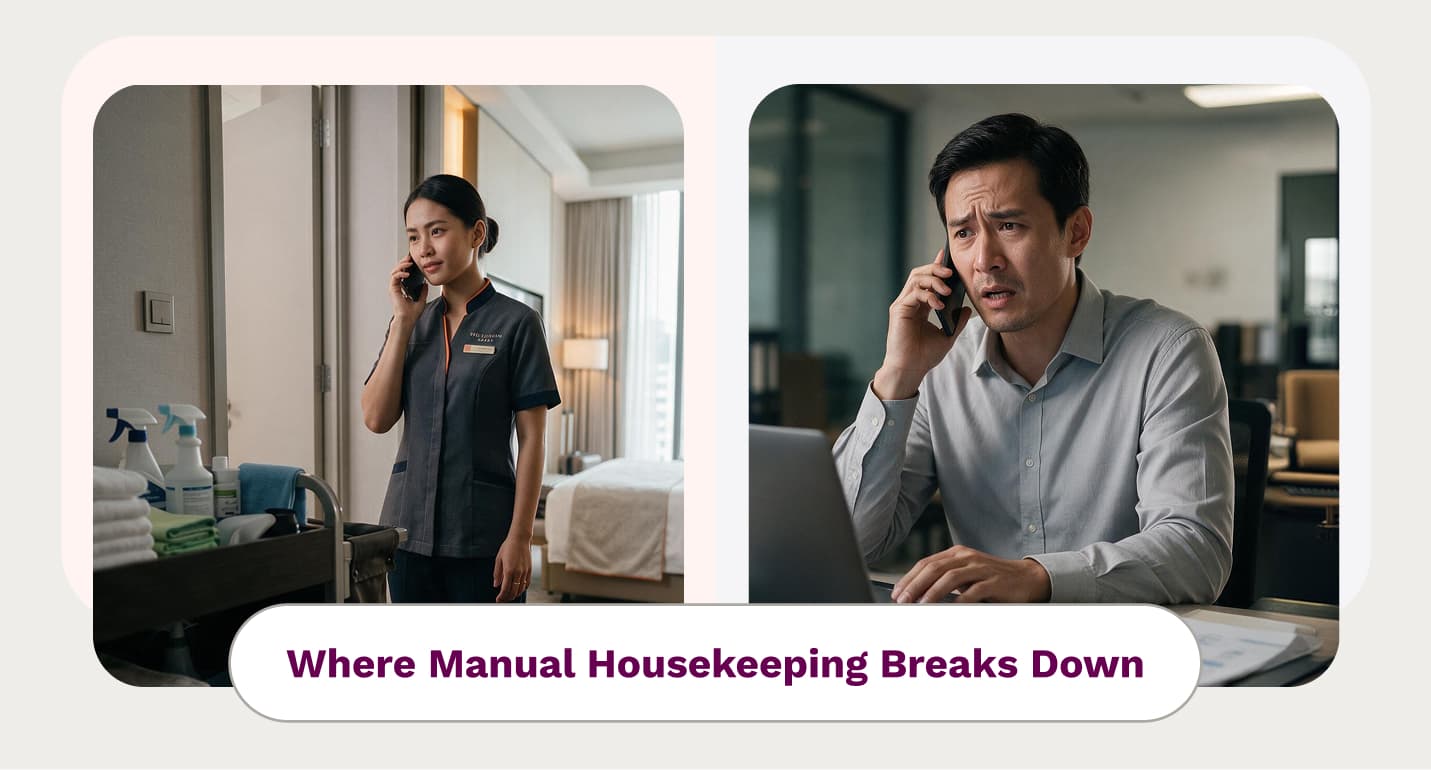
Where Manual Housekeeping Breaks Down
Hospitality operations will always depend on people. The goal is not to replace them, but it’s to reduce time spent coordinating tasks and improve operational efficiency. This is becoming increasingly important as staffing pressures continue.
According to HotelTechReport, 39% of hoteliers view operational efficiency as technology's biggest benefit. Yet, while most technology conversations focus on guest-facing AI, the most destructive operational bottlenecks still happen behind the front desk.
Housekeeping tasks are still commonly managed through phone calls, WhatsApp messages, spreadsheets, or printed room lists. Manual room status updates can create delays and inaccurate availability information, while supervisors often have limited visibility into cleaning progress during busy periods. SOPs and inspection checklists may also be followed inconsistently across teams and shifts, making it difficult to maintain uniform service standards. Maintenance issues identified during cleaning can be reported late or missed entirely.
As a property scales, these small inefficiencies compound into massive operational friction.
What an Automated Housekeeping Workflow Looks Like
The hotel automation system market is projected to grow from US$18.52 billion in 2024 to US$19.68 billion in 2025, reflecting the industry's growing interest in operational efficiency and workflow automation. The temptation to build quick, standalone fixes is high.
We recently heard of a property manager who, using a basic no-code AI tool, built an automation that read Slack messages and automatically created maintenance tickets. Initially, it worked well. Teams no longer had to manually log issues in tickets, and communication became faster.
Then the weekend rush hit.
On a heavy check-in day, cleaners simply worked through the tickets in the chronological order they appeared. Because the tool had no connection to live reservation data, it could not differentiate between a room with early check-in guests versus a late arrival. Supervisors had to manually intervene, scramble priorities and assignments, or re-assign rooms.
True operational automation connects your live guest data directly to your team on the floor. Here is what a fully automated workflow looks like in practice:
Guest checks out → PMS updates room status to "Departure" → Housekeeping work order automatically created → Room assigned to housekeeper based on workload and zone → Housekeeper receives task in mobile app with cleaning SOP checklist → During cleaning, housekeeper reports leaking faucet → Maintenance work order automatically created and assigned to engineering → Housekeeper marks room as cleaned → Engineering completes tasks → Supervisor notified for priority inspection → Room marked ready before guest arrival → Front desk receives real-time update and proceeds with check-in
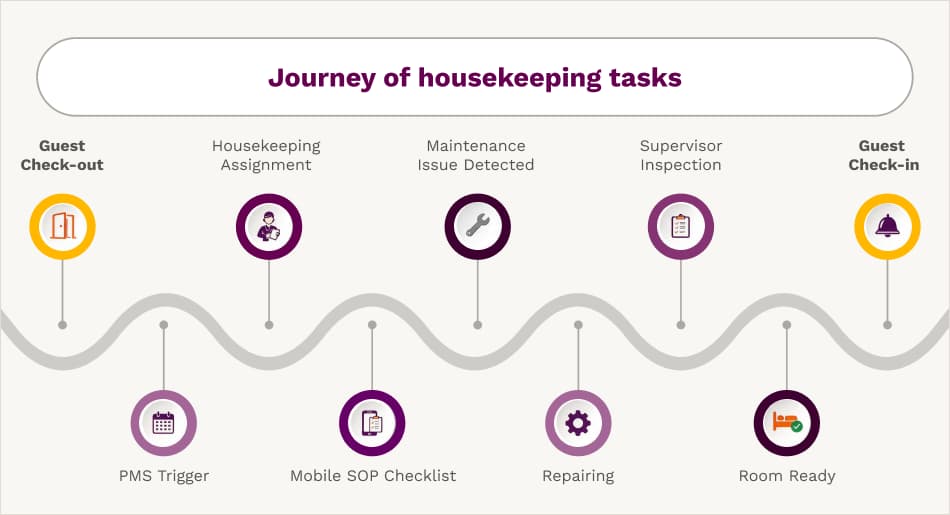
The value of automation lies not in individual tools, but in connected operational workflows.
How Dharma OPS Automates Housekeeping Workflows Without Replacing Your PMS
Dharma OPS was built specifically to serve as this intelligent workflow layer, working seamlessly alongside your existing PMS rather than replacing it. By acting as a central Operational Knowledge Base, reservation data, room statuses, and maintenance alerts flow together in real time.
Managers can automate task assignments, use mobile applications, standardize digital SOPs, track inspections, and monitor room readiness from a centralized dashboard.
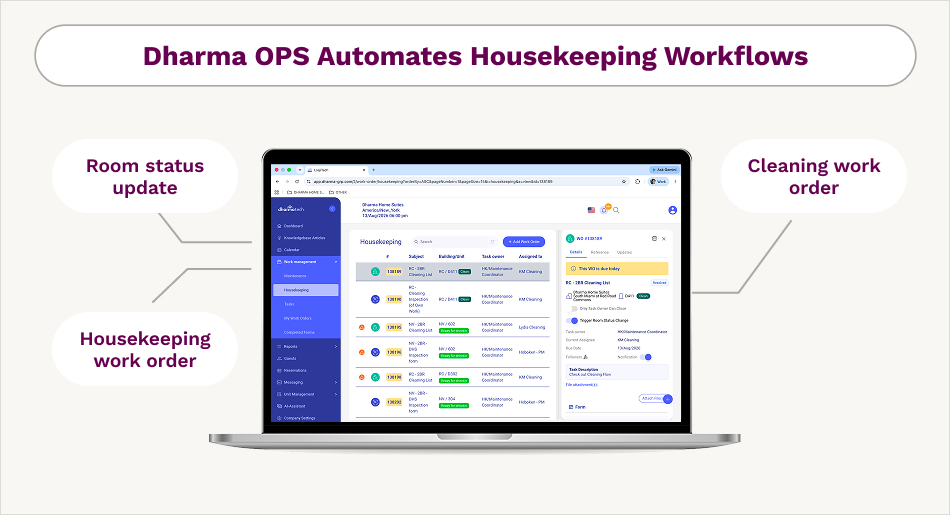
Consider the above same-day arrival scenario. A guest checks out in the morning, and the PMS updates the room status. Dharma OPS automatically creates a housekeeping work order linked to the unit and reservation. Since another guest is arriving later that day, the task is marked as high priority and assigned to the appropriate housekeeper or user group.
The housekeeper receives the assignment on their dashboard along with the property's cleaning SOP and inspection checklist. During cleaning, they discover that the air conditioner is not cooling properly. Instead of relying on calls or messages, they create a maintenance work order directly from their phone app and link it to the room.
The engineering team immediately receives the request, updates the task with notes and photos after completing the repair, and supervisors can track both housekeeping and maintenance progress in real time. By the time the next guest arrives, every team is working from the same operational information.
The value isn’t found in a dozen disconnected tech tools; it’s found in a unified operational workflow.
Evaluating Workflow Automation for Your Property
The impact of right automation extends beyond efficiency. According to a HotelTechReport, 89% of operators say technology makes their teams happier, suggesting that the right technology reduces operational friction rather than adding to it.
Properties that are expanding quickly or managing lean teams may also require operational support alongside automation, which is why a combination of workflow technology and remote operational expertise can maximize your results.
Ultimately, the question is not whether you need more technology, but whether your current systems are making operations easier for your teams using them every day. Are your teams and guests happy?