

.jpg)
Managing a few vacation rentals remotely sounds simple. Set up smart locks. Automate guest messages. Hire a virtual assistant. Connect a PMS. Maybe add a cleaner and a local maintenance person.
Then the portfolio grows.
Suddenly, you are not just managing reservations. You are coordinating cleaning, maintenance, guest requests, owners, all at the same time. After more than 15 years operating vacation rentals and serviced apartments, we learned that the difficult part of remote management isn't being physically absent.
It is losing operational visibility and scalability.
This blog shows how to build that visibility and how remote management only works at scale when the operation itself becomes centralized, connected, and measurable.
Why Do Vacation Rental Operators Need Centralized Remote Operations?
A guest arrives at 11 p.m. and finds the HVAC isn’t working. They ask for a room change, but it’s peak FIFA season and every other unit is sold out. The technician promised to come, but the update gets buried in a text message. The guest eventually leaves. Now imagine the loss: you’ve lost a high-value peak-season booking, have to issue a refund, and could receive a negative review, all because a small maintenance issue wasn’t resolved in time.
The real cost isn’t always the repair. It’s the lack of operational control.
This is why maintenance is not simply a maintenance function. One unresolved repair can affect guest communication, housekeeping, check-in readiness, vendor coordination, refunds, reviews, and owner reporting.
The problem gets worse when every function lives in a different place:
PMS + OTA inbox + WhatsApp + spreadsheets + phone calls + Slack + cleaner group chats + vendor messages.
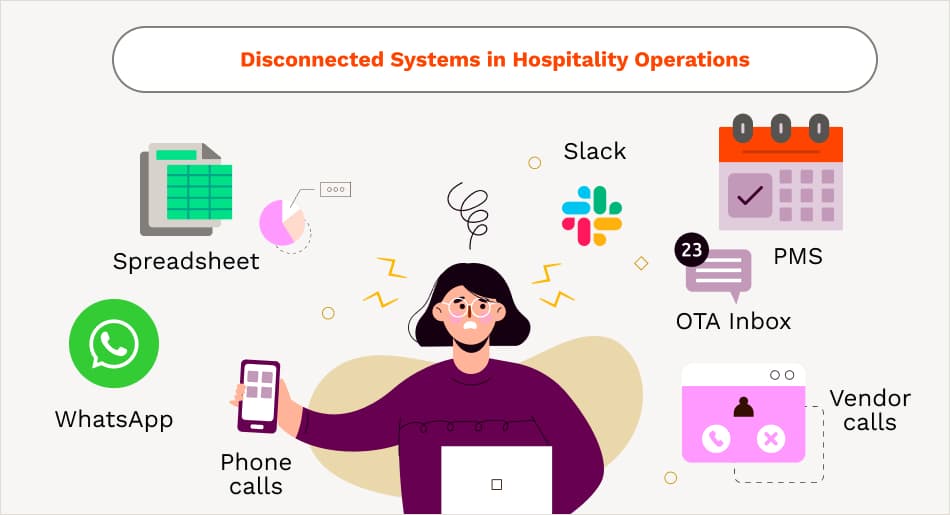
The property manager has to connect all these systems and make sure nothing gets missed. As the business grows, this becomes harder to manage.
And it explains why simply adding AI to a PMS or automating guest messages doesn't solve the whole problem. AI can answer a guest's question, but someone still needs to know whether the maintenance task was assigned, whether the technician arrived, and whether the property is actually ready for the next guest.
The missing layer is a centralized visibility of operations.
What Vacation Rental Operations Can Be Managed Remotely?
To increase the operational visibility as you scale, you can outsource some of the operations. There are many operations like below that can be managed remotely than many property managers assume:
- Guest communication can be managed remotely throughout the guest journey, including booking inquiries, pre-arrival information, check-in support, during-stay requests, after-hours service, and post-stay follow-ups. The complex or sensitive situations can be escalated to a human team. The important distinction is that not every communication should end with a message. A guest request such as "the washing machine isn't working" should become an operational task.
- Housekeeping coordination doesn't require being on-site. Turnovers, inspections, room readiness, linen management, and cleaning schedules can all be coordinated remotely through structured workflows. A remote manager should be able to see the status of work orders and tasks without calling five people to find out what is happening.
- Maintenance coordination can be centralized by receiving requests, creating work orders, assigning technicians, coordinating vendors, tracking progress, and escalating urgent issues before they affect arriving guests.
- Reservations and revenue management can be handled remotely by managing bookings, pricing, occupancy, modifications, cancellations, and maximizing revenue opportunities across the portfolio. Connect reservation information with everything that happens after the booking is made.
- Back-office operations such as owner reporting, payment reconciliation, operational reporting, documentation, and administrative support can be managed centrally without increasing your on-site team.
The next step is finding the right company that will manage your operations remotely and efficiently!
What Property Managers Should Look for in a Remote Operations Company?
Not every remote management solution solves the same problem. Our recommendation is to look for an operations partner with their in-built tech stack and especially look beyond automated messaging and smart locks. There are the important questions to ask:
1. Does it combine technology with operational expertise?
Technology can create a task, but someone still needs to understand what should happen when that task goes wrong. Look for support across guest communication, housekeeping, maintenance, reservations, and back-office operations.
2. Does it integrate with your existing PMS?
Replacing the PMS isn't always the answer. Your PMS already contains valuable reservation and property data. The better question is whether another operational layer can connect that data to what happens on the ground. Phocuswright describes the STR technology market as an expanding ecosystem of management technologies and ancillary services rather than a single system doing everything.
3. Can it operate after hours?
A remote operation doesn't stop when the office closes. You need clear escalation paths for urgent guest requests, maintenance problems, and other exceptions.
4. Is operational information centralized?
Guest history, property information, SOPs, work orders, housekeeping status, maintenance records, and communication should not exist as disconnected pieces of information.
5. Can workflows scale?
An SOP that works for five properties may become a nightmare at 100. The system should allow recurring workflows to be standardized while still supporting property-specific requirements and exceptions.
How to Build a Remote Operations Workflow with Dharma?
The first step isn’t adding another disconnected tool. It’s creating a centralized operational layer that connects your existing PMS, remote teams, and on-site teams, so everyone works from the same operational information.
With Dharma OPS, property, guest, housekeeping, maintenance, task, and operational information can be brought together into a shared source of truth. Instead of managers chasing updates across calls, messages, and spreadsheets, they can see what needs attention and who is responsible for it.
From there, everyday operations can become connected workflows:
- A reservation triggers the relevant housekeeping workflow.
- A guest request becomes a task or maintenance work order.
- An inspection identifies an issue and triggers the next action.
- A maintenance request is assigned to the right person and tracked until completion.
- An SOP can guide the on-site team through the required steps.
- A mobile app allows staff to receive assignments, update statuses, complete checklists, and close tasks without constant calls or messages.
That’s how Dharma Remote Service Management, Dharma OPS, and the Dharma Mobile App work together.
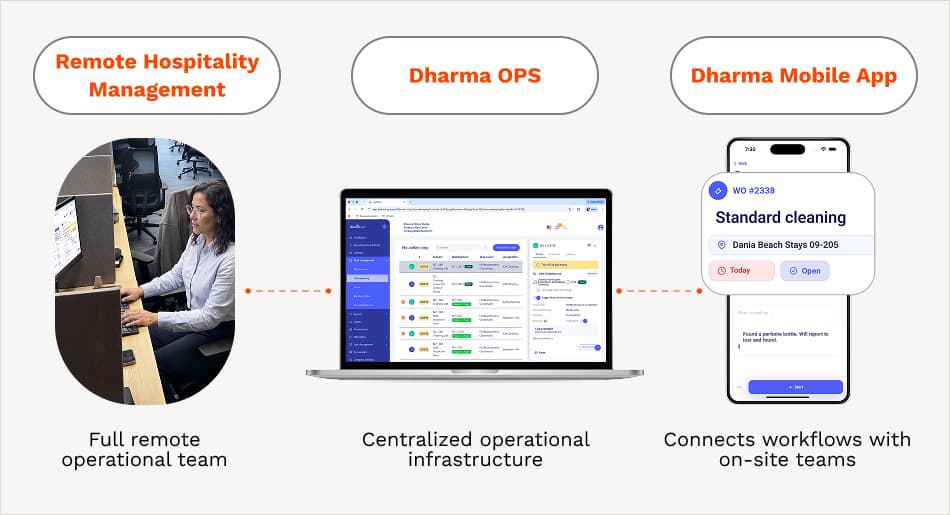
Remote Hospitality Management provides the remote operational team to support guest communication, after-hours service, reservations, housekeeping coordination, maintenance coordination, and revenue-management activities. Dharma OPS provides the centralized operational infrastructure, while the Dharma Mobile App connects that workflow directly with on-site teams.
The workflow then becomes:
PMS → Dharma OPS → Remote Service Team → On-site Team → Guest
This connected approach becomes especially valuable when properties are spread across different locations, on-site teams are distributed, and portfolios approach 100 or more units. At that scale, manual coordination becomes increasingly difficult to sustain.
Your competitors are already ahead: Phocuswright’s 2025 research found that technology adoption is increasingly driven by operators who have grown beyond the point where they can effectively manage their portfolios through manual processes.
Scaling Your Portfolio Without Losing Control
Remote management isn’t about being everywhere. It’s about knowing what’s happening everywhere. As your portfolio grows, connected workflows replace constant follow-ups, giving teams visibility across guests, housekeeping, maintenance, and field operations.
With Dharma Remote Service Management and Dharma OPS working together, operators can scale their portfolio with greater control, faster responses, and less operational stress.
Ready to manage more properties without losing operational control? Book a call to see how Dharma helps you stay connected, organized, and in control from anywhere.