
We all know the excitement of a 'sold-out' notification, but for host-city hoteliers, a mega-event like the FIFA World Cup is something entirely different. It’s a transformative moment that brings both massive opportunity and an undeniable weight of responsibility.
In normal times, stability is your greatest asset. But when a mega-event arrives, that stability is replaced by a high-stakes surge that tests every workflow, from the front desk to the back of the house.
History shows us an important lesson: the hotels that thrive during these moments aren't just those with the most bookings, they are the ones whose operations were built to bend without breaking.
Recent global events provide valuable insights into how demand patterns shift during large-scale international gatherings. Events such as the Paris 2024 Olympics, the 2022 FIFA World Cup in Qatar or Super Bowl consistently demonstrate similar booking and operational patterns.
Several key trends emerge across these events.
Host cities typically experience near-full occupancy during peak event days. In some districts, especially near stadiums or central transit corridors, occupancy rates approach or reach 96.5%.
While this is financially attractive, it also means that hotels operate with zero margin for operational disruption. Even minor service breakdowns can affect hundreds of guests simultaneously.
ADR often increases significantly during mega events. The Summer Olympic Games drove Paris hotel average daily rate (ADR) to an all-time high with a year-over-year room rate increase of 141% and RevPAR growth of 200% as per CoStar.
As you can see, hotels sharply increase their room rates as global demand converges on a limited number of available rooms. While higher ADR improves revenue performance, it also raises guest expectations.
Guests paying premium rates expect premium service. Operational inefficiencies that might be tolerated during normal periods become far more visible.
Mega events often compress booking windows.
Similar to the traditional booking patterns where guests plan months in advance, 171 days before the Paris Games, many travellers also book much closer to the event itself. In many cases, the most intense booking surge occurs within the final 10–14 days based on the results of key matches or event milestones.
This shortened booking window creates significant forecasting challenges for hotel operations teams.
Demand during mega events is highly dynamic. Guest plans often change depending on match results, ticket availability, and travel logistics. As teams advance or are eliminated from tournaments, travel patterns shift accordingly.
Hotels must accommodate frequent booking adjustments, late cancellations, and rapid rebooking activity.
Mega events attract international audiences. Hotels in host cities receive travellers from dozens of countries simultaneously. During Paris Olympics 2024 nearly 9.5 million tickets were sold from 222 different countries.
This introduces new challenges around:
Looking at the scale, guest communication becomes significantly more complex.
Events like the FIFA World Cup take place across multiple host cities. Fans frequently move between cities to follow matches or their average stay days change based on their local exploration plans. Hotels must adapt quickly to offer varied experiences and upsell for more revenue. And each additional offering comes at the expense of more manpower and inventory.
While revenue metrics often dominate industry headlines during mega events, the real impact happens on the day to day operations. On ground teams carry the burden of delivering service at scale.

Several operational areas experience the most pressure.
Housekeeping and Turnover Pressure
Housekeeping teams face intense turnover cycles during mega events. Back-to-back arrivals become common, while late check-outs create cascading delays across floors. Compressed cleaning windows reduce the time available for room preparation.
When occupancy remains near capacity for multiple consecutive days, housekeeping teams must operate at maximum speed without sacrificing quality. This environment increases the risk of delays, missed inspections, or room readiness issues.
Staffing and Onboarding Challenges
Many hotels rely on temporary staff to manage demand spikes during large events. However, temporary workforce integration introduces operational friction. New staff members require onboarding, training, and supervision. Productivity may initially decline as teams adapt to new workflows.
At the same time, existing staff members experience fatigue due to extended shifts and increased workload. Without structured task coordination, operational efficiency declines quickly.
Guest Communication Complexity
Guest communication increases dramatically during mega events. Travellers request information about transportation, match schedules, ticket logistics, and city navigation. Messages arrive across multiple channels including email, messaging apps, booking platforms, and hotel apps.
Response speed and multilingual expectations also increase. Guests expect prompt and precise replies regardless of the communication channel they use. Managing this volume manually becomes extremely difficult.
Data and Coordination Gaps
Hotels often operate with multiple disconnected systems. Property management systems handle reservations, housekeeping tools manage cleaning tasks, and communication platforms handle guest messaging. Without real-time visibility across these systems, coordination gaps emerge.
Managers struggle to track task completion, monitor staff workloads, or identify operational bottlenecks quickly. During mega events, these gaps become amplified.
Scale Magnifies Existing Weaknesses
FIFA-level demand does not create operational weaknesses. It magnifies them. Workflows that function during normal occupancy levels may fail under sustained pressure. Hotels that rely on manual coordination, fragmented systems, or informal communication channels often experience operational breakdowns during peak demand.
Hotels preparing for mega events must rethink how tech can enable their operations smoothly. Rather than relying solely on additional staffing or manual coordination, many operators are adopting modern operational tools that improve visibility, communication, and task management.
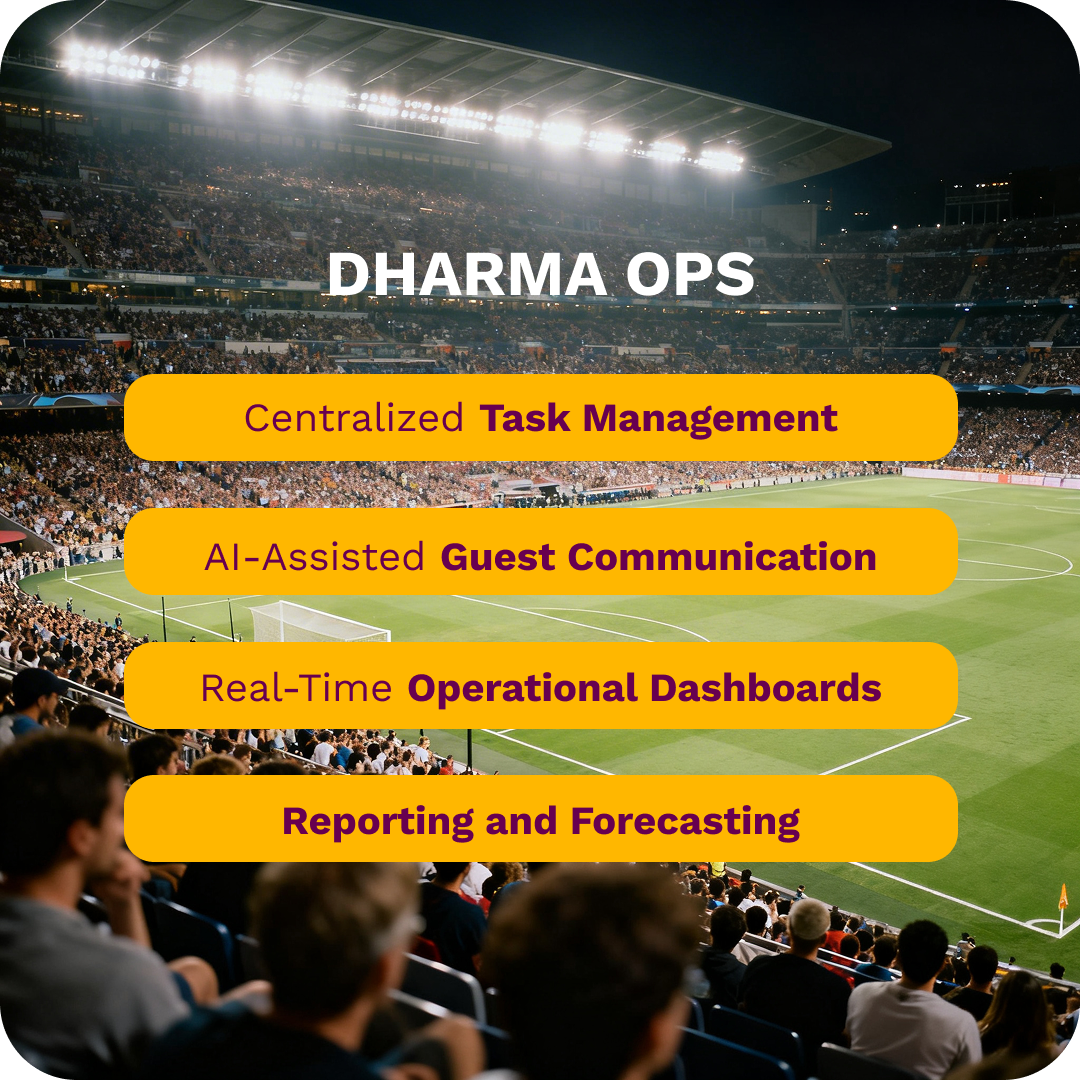
Several capabilities are becoming increasingly important.
Centralized Task Management: A structured task management system allows hotel teams to track operational workflows across departments. Housekeeping tasks, maintenance requests, and service requests can be assigned, monitored, and completed in a coordinated manner. This ensures accountability and reduces delays during high-pressure periods.
AI-Assisted Guest Communication: Unified guest communication platforms allow hotels to manage conversations across multiple channels from a single interface. AI-assisted tools trained on your hotel policies can help respond to common questions, manage multilingual conversations, and reduce response times during peak demand. This significantly improves the guest experience.
Real-Time Operational Dashboards: For hotels operating multiple properties or large buildings, real-time dashboards provide visibility across all operational activities. Managers can monitor room readiness, housekeeping progress, guest requests, and staff performance in real time. This allows faster decision-making when operational issues arise.
Reporting and Forecasting: Operational data collected during mega events can also help hotels forecast future demand patterns and improve staffing models. Advanced reporting tools allow operators to identify bottlenecks, optimise staffing levels, and improve workflow design for future peak periods.
In the modern hospitality world, these improvements do not require replacing existing property management systems (PMS).
Our solution, Dharma OPS, is designed to provide this operational layer by connecting guest communication, task management, and workflow coordination in a single platform.
The FIFA World Cup represents one of the most significant opportunities the hospitality industry experiences. Hotels in host cities can achieve record occupancy levels, exceptional revenue performance, and global brand exposure. However, the real determinant of success is operational execution.
Hotels that prepare their workflows, communication systems, and operational infrastructure in advance will be able to maintain service quality even under intense demand pressure. Curious how Dharma OPS can help you smoothly execute your hotel operations during mega-events?

.svg)